
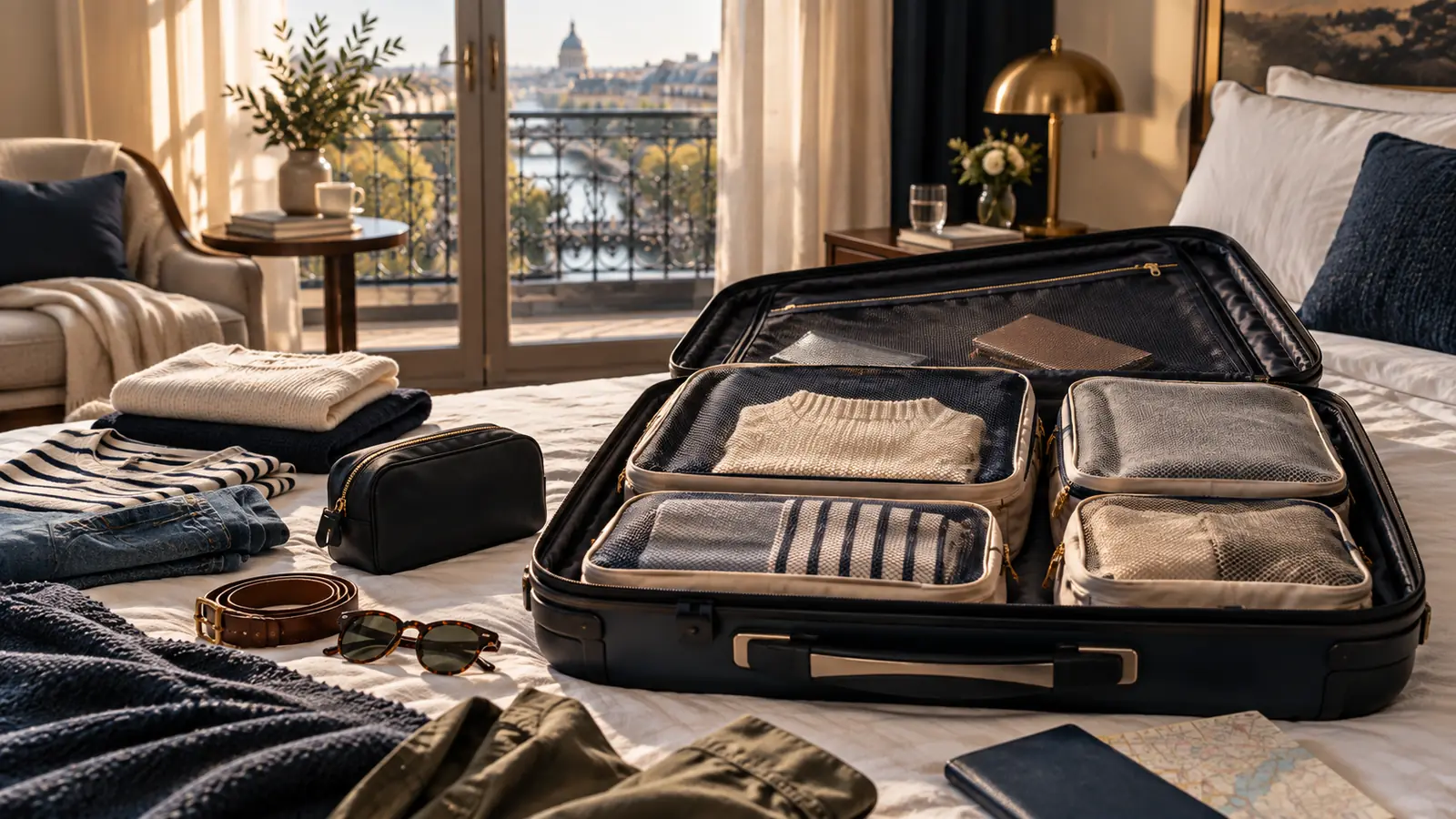
They are less useful when the real problem is an oversized packing list. Regular packing cubes do not make clothing lighter, and they do not automatically create more usable space. They also add their own weight, cost and routines.
The short answer is therefore conditional: use packing cubes if separation will remove more friction than the cubes add. Use fewer if only one or two categories need containing. Leave them behind if your bag already provides enough structure or if you pack lightly without losing track of anything.
Before asking which cubes to buy, ask what problem they would solve
Packing cubes are often presented as a general cure for difficult packing. That skips the decision that matters.
Is the problem that you cannot find a clean shirt without disturbing everything else? A cube may help. Is the problem that eight days of clothing will not fit into a five-day bag? A regular cube cannot edit that list for you. Is the problem a strict weight allowance? Adding another layer of fabric and zips moves in the wrong direction, even if the bag looks neater.
The useful question is not, “Do organised travellers own packing cubes?” It is, “What recurring task would this extra object make easier?” If there is no specific answer, there is no strong reason to buy one.
What regular packing cubes actually do
A regular packing cube is a zipped fabric container placed inside a larger bag. Its main job is containment. It gives selected items a boundary and keeps that group together as the bag is carried, opened and repacked.
That can be valuable in several ways:
- Clothing can remain grouped by person, type or stage of a trip.
- One category can be removed without unloading the whole bag.
- Clean and worn clothing can be separated if the system includes a suitable second container.
- A deep, mostly empty compartment can become easier to navigate.
- Packing can become repeatable: the same category returns to the same place on each trip.
Think of cubes as removable drawers, not as a smaller suitcase hidden inside the first one. Their value comes from access and separation.
What they do not automatically do
They do not shrink the packing list
A cube can impose a useful limit—when the cube is full, that category is full—but it cannot decide which fourth pair of trousers stays home. If every cube is overfilled and more loose items are pushed around them, the same overpacking problem remains in a tidier form.
They do not reduce luggage weight
The clothes weigh the same inside or outside a cube. The cube adds tare weight: the weight of the organiser before anything is placed inside it.
Manufacturer specifications show why the design matters. Eagle Creek lists its Pack-It Isolate Cube M at 1.5 ounces (43 grams), while Peak Design describes its Packing Cube as a more structured compression design. These are named examples, not category averages. “Lightweight” is too vague to guide a weight-conscious traveller: the exact model, size and number carried matter.
Regular cubes are not the same as compression systems
Neat folding may make a load more orderly, but a regular cube has no mechanism designed to squeeze air out of clothing. A compression cube adds a second zip that reduces the package's depth. Roll-to-expel-air bags and valve-based vacuum bags work differently again.
If fitting bulky clothing is the actual problem, see Packing Cubes vs Compression Bags before buying an organiser for a compression job.
They are not automatically waterproof or wrinkle-proof
Fabric treatments may provide some water resistance, but a standard zipped cube should not be treated as a sealed barrier unless its maker supplies an appropriate, specific rating. Likewise, a cube can stop a folded stack from spreading through the bag; it cannot guarantee crease-free clothing. Fabric, folding, pressure and the way the bag is handled all still matter.
When packing cubes genuinely earn their place
Packing cubes make the strongest case when they solve a recurring access problem.
You change accommodation often
On a multi-stop trip, repeatedly unpacking and rebuilding one large compartment creates work. A small set of stable categories can be moved between bag and room with less disruption.
Several people share one bag
Containment can provide clear ownership without adding a complicated labelling system. One cube per person may be more useful than one cube per clothing type. That is an organisational decision, not a rule about the correct number.
Your bag is one large cavity
A suitcase or backpack with few internal dividers can benefit from modular structure. By contrast, a bag already divided into useful compartments may need little help.
You need reliable access to one category
If sleepwear, base layers or children's clothing must be found quickly, a dedicated cube can prevent an entire bag search. The benefit is strongest when the category is used repeatedly, not merely because it exists.
A cube helps enforce a deliberate limit
An organiser can serve as a boundary: when the designated clothing cube closes comfortably, that category is finished. This only works if the traveller respects the boundary. Compression and force are not substitutes for editing.
The trade-off: space, weight, cost and complexity
Swipe horizontally to compare all columns. Keyboard: focus the table and use the arrow keys.
| Test | What a cube may give you | What it asks in return |
|---|---|---|
| Space | Stable groups and easier access | Fabric, seams and shapes that may leave gaps |
| Weight | No weight saving | Additional tare weight for every cube |
| Cost | A reusable system | Money spent on an organiser rather than the trip itself |
| Complexity | Repeatable categories | More zips, containers and decisions to maintain |
| Flexibility | Modules that move between bags | Rectangular modules may fit curved or shallow bags poorly |
The geometric cost is easy to miss. A soft garment can fill an irregular corner. A rectangular cube may not. In a square suitcase this may be negligible; in a tapered backpack it can leave awkward pockets of unused space. The cube's shape needs to work with the bag, not merely fit inside it.
Cost deserves the same treatment. An expensive set is not automatically wasteful, and a cheap set is not automatically good value. The relevant question is how many pieces will be used often enough to justify owning and carrying them. A set that supplies six shapes when two solve the problem has created inventory, not efficiency.
Who should use packing cubes?
They are most likely to earn their place for:
- travellers who change accommodation several times;
- families or companions dividing one case;
- people using a large, lightly structured main compartment;
- travellers who repeatedly need one category without disturbing the rest; and
- people who already use simple, consistent packing categories.
Notice what is missing from that list: a particular trip length. A three-day trip with frequent moves may benefit more than a ten-day stay in one room. Behaviour matters more than the calendar.
Who should skip them?
Leave packing cubes behind if any of these descriptions fits:
- Your bag already has dividers that match the way you pack.
- You take so little that every item remains visible and accessible.
- A strict weight allowance makes each added gram difficult to justify.
- Your soft or curved bag packs more efficiently when clothing fills irregular spaces.
- You dislike maintaining categories and will put items into whichever cube is open.
- You are hoping an organiser will make an unedited list fit.
A cube should remove a repeated frustration. If using it creates another routine that you resent, it has not earned its place.
Simpler alternatives may be enough
The no-purchase option is to assign fixed zones within the bag: tops on one side, base layers in a pocket, worn clothing in a bag already available at home. A single reusable pouch or drawstring sack can contain one troublesome category without turning the whole bag into a modular system.
Loose packing also has a legitimate advantage: soft items can occupy the exact shape left around shoes, toiletry containers or the edges of a backpack. For a light packer, that flexibility may matter more than perfect separation.
If one category causes nearly all the rummaging, start with one cube rather than a set. How Many Packing Cubes Do You Need? provides a method for deriving the number from your bag and categories.
A quick decision test
Ask these four questions before buying:
- What gets lost or disturbed now? Name the actual category or task.
- How often does that happen? A recurring problem deserves more attention than a hypothetical one.
- Does the bag already solve it? Use built-in structure before adding another system.
- Would one container solve most of it? Start with the smallest intervention that works.
If the answers are specific, cubes may be useful. If the answers remain abstract—“I want to feel more organised”—wait until a real packing problem appears.
Worth Bringing verdict
Worth bringing with conditions. Packing cubes earn their place as an organisation system for travellers who repeatedly need separation and faster access. They are not a default purchase, a weight-saving device or a repair for overpacking.
If cubes make sense, begin with the smallest arrangement that solves the named problem and add another only when it has a separate job. Use only as many as perform that job, and leave the rest behind.
Next, choose the page that matches the decision you actually face:
- If the question is organisation versus volume, read Packing Cubes vs Compression Bags.
- If cubes already make sense and the question is quantity, read How Many Packing Cubes Do You Need?.
- If the packing list itself is the problem, use How to Pack a Carry-On for 7 Days before adding organisers.
Sources and methodology
This is a research-based category guide, not a hands-on review. The verdict combines product mechanics and manufacturer specifications with “Worth Bringing”’s space/weight/cost/complexity framework.
- Eagle Creek — Pack-It Isolate Cube M (opens in a new tab): manufacturer specifications for capacity, dimensions, material and weight.
- Peak Design — Packing Cube (opens in a new tab): manufacturer description of the compression mechanism and current size choices; numeric variant specifications are not cited here.
Manufacturer figures describe the named products only. They are not treated as category averages or as proof of real-world performance.