
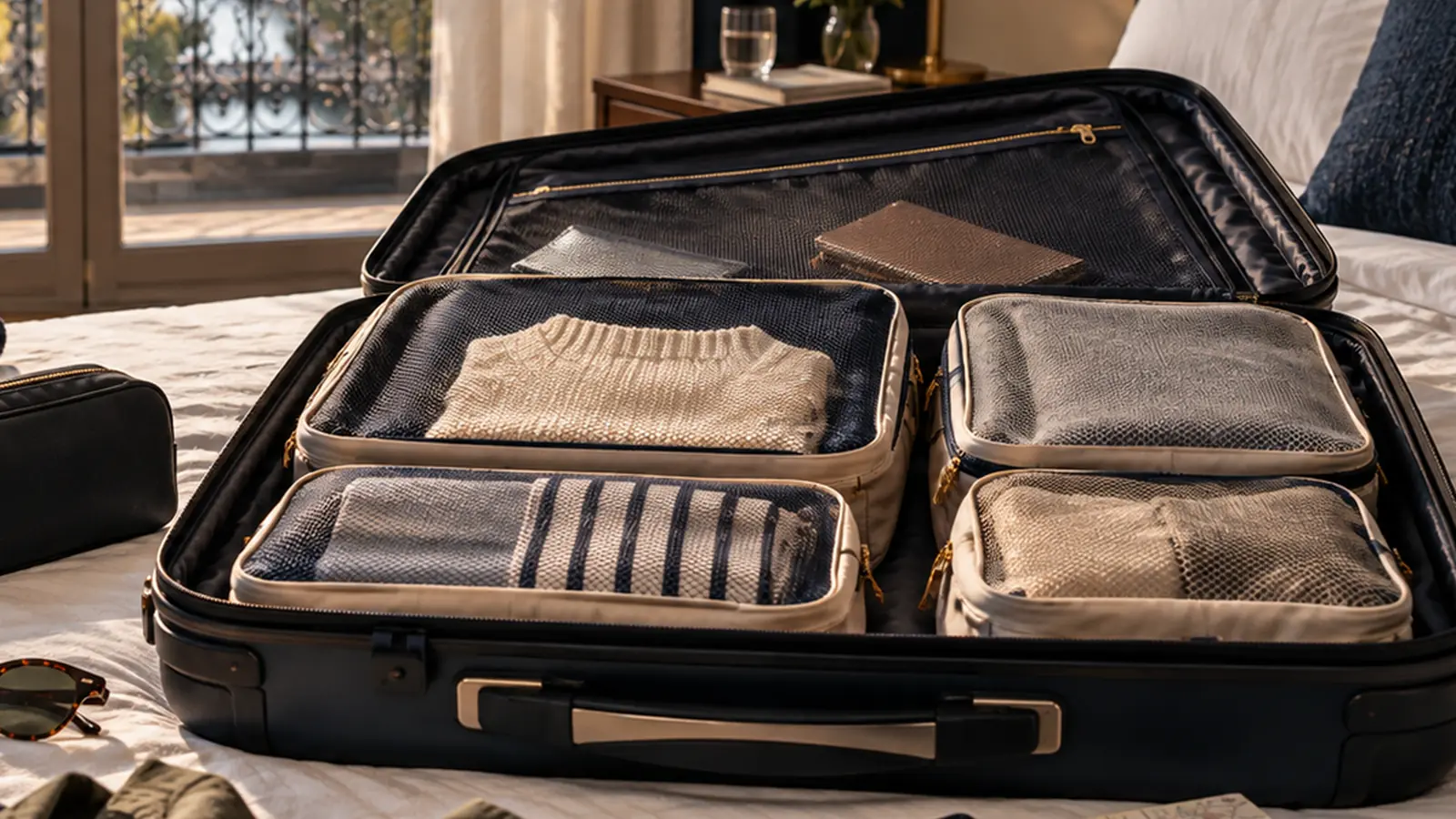
For one person that may be three cubes. For another it may be one. For a light load or a highly divided backpack, the correct answer can be zero.
Do not begin with the number printed on a bundle. Begin with the bag's usable shape, the clothing being carried and the categories that need repeated access. Buy the system—not the set.
Categories come before cube count
The number of cubes should follow from what each cube will do. “One cube because it came in the package” is not a job. “Keep base layers together so they can be found without unloading the bag” is.
Write down the clothing groups that would benefit from containment. A possible list might include:
- main clothing;
- underwear and socks;
- sleepwear;
- activity or swimwear; and
- worn clothing during the return journey.
Do not automatically turn every category into a cube. Toiletries need leak-aware containment, not simply a fabric box. Fragile electronics need suitable protection and cable management. Shoes may need a washable barrier, but a bag already at home could do that job. Documents need secure, quick access rather than a place among clothing.
Combine groups that are always used together. Remove groups that remain easy to identify without a container. The count left after that exercise is the first useful estimate.
Measure the bag before choosing the cubes
Capacity in litres does not reveal the whole packing shape. Two bags with similar stated capacity can have different internal dimensions, curved sides, wheel housings, frames, pockets or divided panels. There is no single carry-on volume on which a universal cube formula can rest.
Measure the usable clothing compartment rather than the outside of the bag:
- Length and width: Record the flat floor available after accounting for wheel housings, frames or built-in pockets.
- Depth: Measure how much height is available without making the closure strain or the back panel bulge.
- Divisions: Treat each clamshell half or fixed compartment separately.
- Obstructions: Note tapered corners and spaces already claimed by shoes, wash kit or equipment.
- Opening: Confirm that a filled cube can pass comfortably through the bag's opening, not merely fit once inside.
Then compare those measurements with the manufacturer's dimensions for the exact cube size under consideration. If the cube expands or compresses, note which dimensions apply in each state.
A simple paper template can prevent an unnecessary purchase. Mark the cube's stated footprint on paper and place it in the empty bag. This does not prove how the cube will perform when filled, but it can reveal obvious conflicts between rectangular organisers and the bag's usable floor.
Account for depth, not just the footprint
Packing layouts are often planned as if everything were flat. A cube that appears to tile neatly across a bag may be too deep once filled. The result can be a bowed panel, strained zip or unusable space above and around the organiser.
Depth also changes with the contents. A loosely filled fabric cube may settle into the bag. A tightly packed or compressed cube behaves more like a dense block. Without firsthand testing, the exact filled shape cannot be promised from an empty-product specification.
Leave tolerance rather than designing a perfect edge-to-edge diagram. The bag still needs to close, and soft items or a jacket may use the remaining irregular spaces more effectively than another cube.
Fewer large cubes or more small cubes?
Neither arrangement is automatically better. The decision is between access and overhead.
Swipe horizontally to compare all columns. Keyboard: focus the table and use the arrow keys.
| Layout | Advantages | Costs | Best fit |
|---|---|---|---|
| One medium or large cube | Low container count; simple routine | Categories share one space; large block may fit poorly | One troublesome clothing group or simple packing list |
| Two or three mixed sizes | Useful separation without turning every item into a module | Requires planning and some added weight | Carry-on load with a few stable categories |
| Several small cubes | Fine-grained access and easy division between people | More seams, zips, tare weight and fixed edges | Multiple small categories that are accessed separately |
| No cubes | No added cost or weight; flexible use of irregular space | Less containment | Light load or bag with effective built-in organisation |
A larger cube is efficient only if its contents belong together and the block suits the bag. Smaller cubes are useful only when each category needs separate access. Otherwise, extra pieces create work without solving another problem.
The one-cube scenario
One cube is a clean, low-commitment trial when a single category creates most of the friction.
Use one for the category that is small, scattered or repeatedly needed—perhaps underwear and socks, sleepwear or children's clothing. Leave trousers, jumpers or other bulky items loose if they fill the bag's shape more effectively.
This arrangement keeps the experiment controlled: one container, one named job. If that cube consistently improves access, another category can be considered later. If it remains mostly empty or is ignored, the system has answered the question without leaving a drawer full of unused pieces.
The zero-cube scenario
Zero is a deliberate answer, not a failure to organise.
Skip cubes when:
- the bag's built-in mesh panels and pockets already create useful zones;
- the load is small enough to see at a glance;
- clothing needs to fill curved or narrow spaces around other items;
- every added gram matters; or
- the traveller prefers one packing sequence over several containers.
For a short trip in a small daypack, adding a system can create more friction than it removes. The bag itself may already be the organiser.
If the underlying decision is still whether cubes provide any value, read Are Packing Cubes Worth It? before choosing a quantity.
The Worth Bringing three-cube starting framework
For a carry-on bag with one main clothing compartment, “Worth Bringing”’s practical starting framework is:
- One medium cube for the main clothing group—for example, tops and compatible layers.
- One small cube for underwear and socks.
- One small cube for a distinct, repeatedly accessed group—perhaps sleepwear, swimwear or activity clothing.
This is analytical guidance, not an externally proven ideal. It is useful because it creates three clear jobs without requiring every item to live in a container. It should be modified or rejected when the bag and load point elsewhere.
Reduce it to two when
- the third category is too small to justify a container;
- one small cube can hold compatible categories without harming access;
- the bag's built-in pocket already handles the third group; or
- loose bulky pieces need the remaining space.
Reduce it to one when
- only small items cause rummaging;
- the trip uses a minimal, repeatable clothing list; or
- a first-time cube user wants to test the system without buying a full layout.
Increase it only when
- another category has a distinct, recurring access need;
- two people are being separated within one bag;
- clean and worn items need independent containment; or
- the trip has clearly different activity modules that should be removed separately.
Do not add a cube merely because another rectangle fits on the floor plan. It must also earn its weight, depth, cost and maintenance.
Trip length changes the load, not automatically the count
A longer trip may require more clothing, but it does not necessarily create more categories. A traveller who launders and repeats the same compact wardrobe may use the same cube layout for four days and two weeks. Another traveller may need an additional activity module for one specialised weekend.
Derive the count from the actual load and access pattern. “One cube per day” confuses duration with organisation and creates a system that becomes more complicated precisely when the trip gets longer.
If the list for a week is still unsettled, work through How to Pack a Carry-On for 7 Days before buying organisers. Cube count should follow the approved load.
Compression changes the sizing question
If the cube has a secondary compression zip, compare both its expanded and compressed dimensions and capacity as stated by the manufacturer. Do not assume the compressed state will be reached with every fabric or that the cube's maximum expanded capacity will remain easy to close.
Soft, lofted clothing behaves differently from dense clothing. Compression also produces a denser package, which can alter how the bag carries even though it does not change the weight of the contents.
For the mechanical distinctions, see Packing Cubes vs Compression Bags. This guide is about how many modules to use after the type of system has been chosen.
How to assess a pre-packed set
A bundle may be good value, but the number of pieces is not evidence that the pieces form a useful system.
Before buying, give every included item a job. Copy this checklist into your notes and complete one row for each piece in the set:
Swipe horizontally to compare all columns. Keyboard: focus the table and use the arrow keys.
| Included piece | Intended job | Fits measured compartment? | Replaces something already owned? | Carry regularly? |
|---|---|---|---|---|
| Large cube | Your intended job | Yes / No | Yes / No | Yes / No |
| Medium cube | Your intended job | Yes / No | Yes / No | Yes / No |
| Small cube | Your intended job | Yes / No | Yes / No | Yes / No |
| Specialist pouch | Your intended job | Yes / No | Yes / No | Yes / No |
If several rows have no clear job, compare the cost and weight of the pieces that will actually be used with suitable individual cubes. Do not assume either route is always cheaper; prices and bundles change.
Who should skip a multi-cube system?
Leave a multi-cube layout behind if the bag is already divided, the traveller carries very little or the categories will not be maintained. Also skip it when the cubes force soft clothing away from useful gaps or when the cumulative tare weight matters more than separation.
The system should make packing and daily access simpler. If it requires a map to remember which near-identical pouch contains which item, the organisation has become the task.
Simpler alternatives
Use the bag's existing divider, a laundry bag already owned, one drawstring pouch or one cube for the only difficult category. Loose-folded or rolled clothing can fill irregular spaces without adding another purchase.
Another low-cost approach is to test the category plan at home with temporary pouches of similar dimensions. This can reveal whether the categories and layout make sense. It is a planning exercise, not evidence of the performance of a product later purchased.
Worth Bringing verdict
Start with zero, one or three—not because those are magic numbers, but because they represent three clear levels of intervention.
- Choose zero when the bag and light load already provide enough structure.
- Choose one when a single category creates most of the friction.
- Use the three-cube framework when a carry-on clothing compartment benefits from a main group and two genuinely distinct smaller groups.
Then modify the arrangement using measured bag geometry and actual categories. The right number is reached when every cube has a job and another cube would add more weight, edges and maintenance than useful separation.
Buy the system—not the set.
Sources and methodology
This article is a decision framework. It does not claim that a particular number is proven optimal or commonly used. The quantity and layout recommendations are “Worth Bringing” analysis derived from bag geometry, category logic and the brand's space/weight/cost/complexity test.
Check product dimensions, weight and capacity against the exact current model and size. The sources below include:
- Eagle Creek — Pack-It Isolate Cube M (opens in a new tab): manufacturer dimensions, capacity, material and weight for one named example.
- Peak Design — Packing Cube (opens in a new tab): manufacturer dimensions, expanded/compressed capacity, material and weight for one named example.
Neither example establishes a universal cube size.