
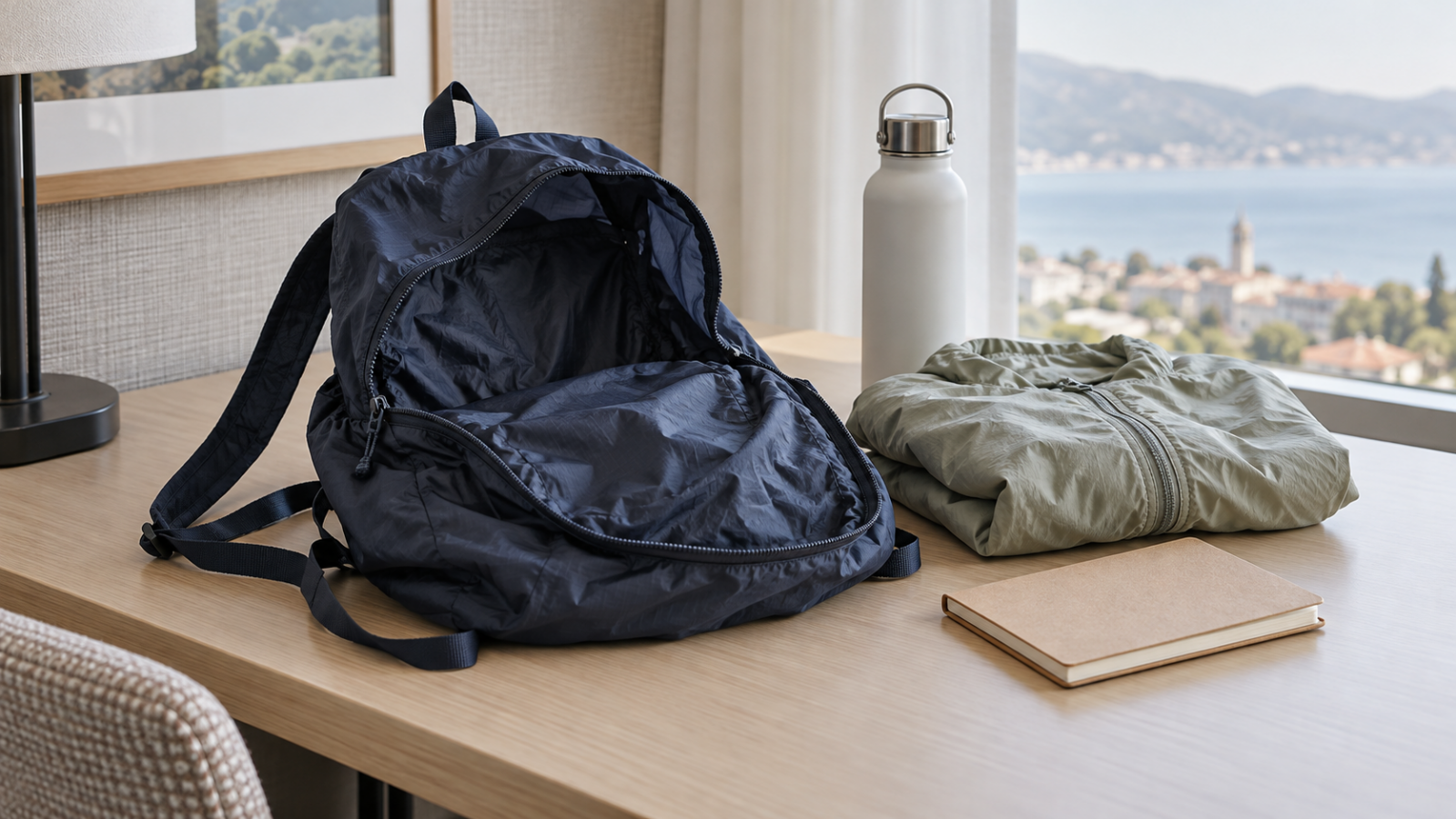
Whether that problem is real depends on your daily load, and the load decides how much structure the bag needs. Choose the load first and the bag second.
Start with your load
Comfort depends on the specific bag, how it is packed and who is carrying it, so no single comfortable-load number applies. This table is “Worth Bringing” analysis of how load relates to design.
Swipe horizontally to compare all columns. Keyboard: focus the table and use the arrow keys.
| What you will carry | Is a second bag needed? | Structure that matters |
|---|---|---|
| Phone, wallet and passport | Probably not. A pocket or a sling you own may do | None |
| A layer and a water bottle | Possibly. A minimal packable can fit | Light; padded straps may help |
| Something dense or heavy: tablet and charger, camera gear, groceries, beach gear | Often, depending on what you own and how it packs. Consider existing options first | More relevant: back panel, padded straps, organisation |
If your actual daily carry is pocket-sized, the case for a secondary bag, packable or not, is weak before you look at any product.
“Packable” is a spectrum
It is a mistake to treat every packable daypack as flimsy, unpadded or bad for tech. Current designs span a range. These three show it. They are illustrations of how published specifications differ, not recommendations or a ranking.
Swipe horizontally to compare all columns. Keyboard: focus the table and use the arrow keys.
| Bag | Weight | Capacity | Structure details | Where the information comes from |
|---|---|---|---|---|
| Sea to Summit Ultra-Sil Day Pack | 68 g | 20 L, version reviewed by Pack Hacker | The reviewed version lacked padding and internal organisation; current versions may differ | Pack Hacker’s independent review; its finding describes that model only |
| Osprey Ultralight Stuff Pack, selected US listing | About 149 g (0.329 lb) | 18 L | Recycled 40D high-tenacity nylon, padded mesh shoulder straps, adjustable sternum strap | Manufacturer’s published specification for the selected regional/model listing |
| Matador 18L Packable Backpack, Garnet listing | 255 g | 18 L | Structured, padded, breathable shoulder straps; removable sternum strap; compression straps; dual bottle pockets | Manufacturer’s published specification for the selected regional/model listing |
The Sea to Summit entry is reported by Pack Hacker; the other entries use manufacturer specifications. “Worth Bringing” did not measure these bags. A spec sheet tells you what a bag has, not how it performs.
Sources for this section: Osprey selected US Ultralight Stuff Pack listing (opens in a new tab); Matador 18L Garnet listing (opens in a new tab); Pack Hacker Ultra Sil reviewed version (opens in a new tab).
What a spec sheet cannot tell you
Comfort after hours of wear, a realistic comfortable load, zip durability, abrasion resistance and performance in wet weather cannot be read from a listing, and this guide cannot settle them. A padded strap or structured back panel makes some outcomes more plausible. It does not prove them.
Choosing structure
Minimal and structured designs trade different things. This is inference from design, not a test result.
- Minimal, unstructured: may take up less packed room and weigh less, but that depends on the specific products, so compare listed figures. With no back panel, what is inside can press against your back, which matters more for dense items.
- Structured, padded: may weigh more and take more packed room, depending on the product. Padding, a back panel and organisation are more relevant when you carry heavier or denser loads.
Match the design to your load from the table above. Don’t assume the most packable model, or the most structured one, is automatically right.
What else could do the job
None of these is universally better. Each suits a different load.
Swipe horizontally to compare all columns. Keyboard: focus the table and use the arrow keys.
| Option | Suits | Catch |
|---|---|---|
| Your main travel backpack (see how to choose a carry-on travel backpack) | Trips where you are comfortable using it for sightseeing | May be larger than you need for the day |
| A travel sling | A small load: phone, wallet, passport and a few compact essentials | Little room for more |
| A packable tote | Loose or bulky items such as beach gear or souvenirs | Less structure and hands-free comfort |
| A standard daypack you already own, laid flat in your luggage | When you have packed space to spare | Takes up that space and adds to the main bag’s weight |
When buying nothing is the right call
- Your daily carry is very small. A sling you own, or clothing pockets, may be enough.
- You have room to spare. An existing daypack laid flat keeps its structure and organisation without a new purchase.
- Your main bag is compact enough for day use. You may be able to unpack at your accommodation and use the same bag.
If you decide to buy
Compare listings on these points:
- Weight and packed size against the space you would give up.
- Capacity and load fit against your own load band.
- Back panel and strap padding, which matter more for denser loads.
- Features you will use: sternum strap, compression straps, bottle pockets.
- Fabric and closure details as the maker states them, treated as claims.
If you plan to use it as a personal item
A packable daypack inside your main luggage is part of that luggage. Its weight and volume still count towards that bag’s overall allowance, so check the limit that applies to the bag it travels in. If you plan to carry it as an additional personal item on a flight, what counts is its packed dimensions when loaded, not its rolled-up size. Check its dimensions, weight and permitted bag count against the rules for your ticket and airline, and see what to pack in a personal item bag for how that bag is best used. A packable bag does not automatically qualify.
Before you buy anything
- What will you actually carry on a typical day: pocket-sized, a layer and water, or something denser?
- Do you already own a daypack, sling or tote that could do this?
- Is there room to lay an existing daypack flat in your main luggage?
- Does the load need real structure, or is a minimal stuff-sack style enough?
- If it will double as a personal item, have you checked your airline’s rule using the bag’s packed size?
This guide is research-based and does not report hands-on testing of the products discussed. Product details are examples, not rankings; manufacturer claims are attributed as such.