
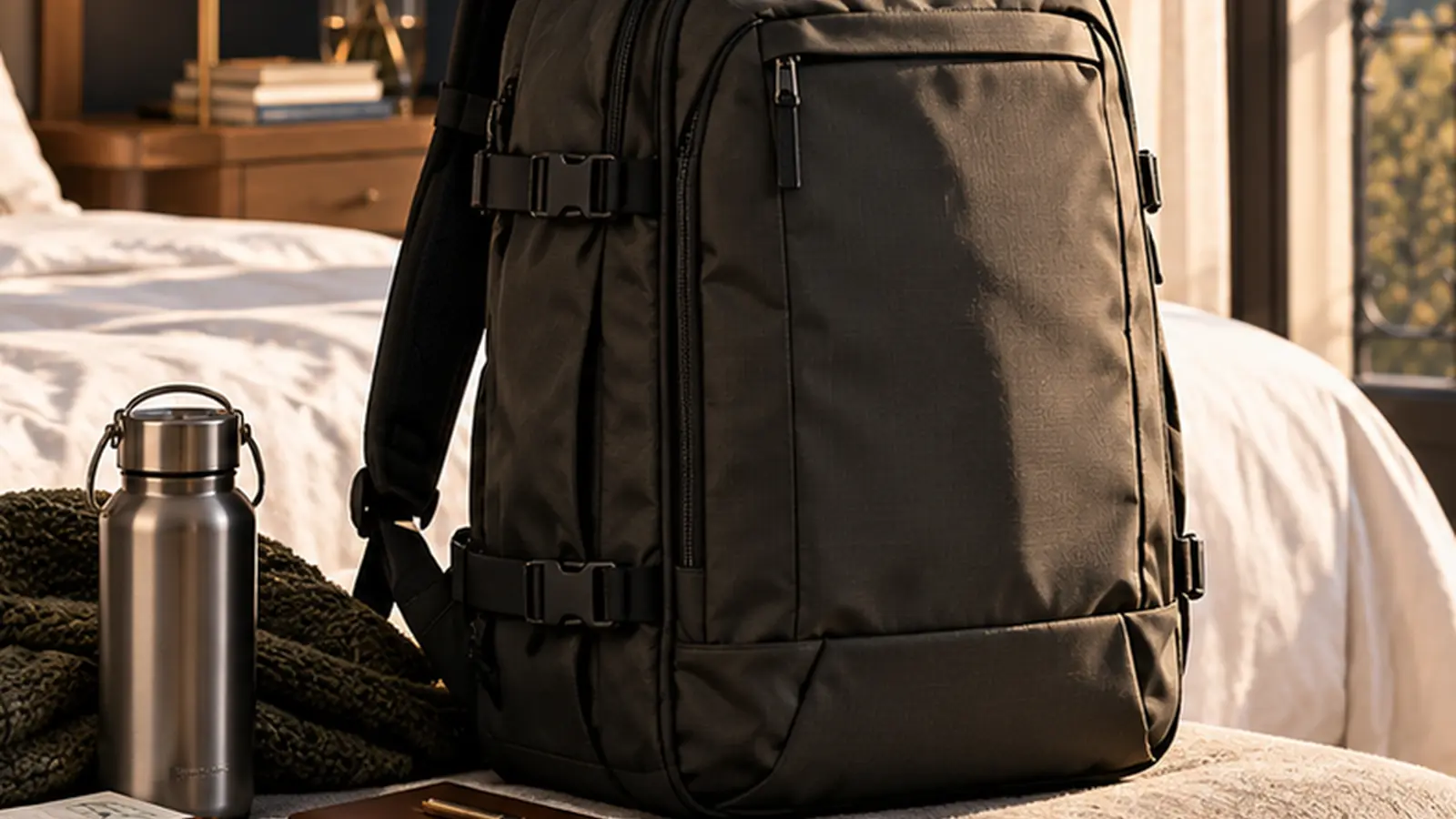
Litres alone cannot tell you whether a bag complies with an airline, fits your body or works for the way you travel. A larger feature list cannot repair the wrong dimensions or an unsuitable carry system.
If you have not yet decided between wearing and rolling the load, pause here and use Travel Backpack vs Rolling Carry-On. This guide begins after the backpack format has earned its place.
1. Start with the airline envelope
“Carry-on backpack” and “airline approved” are not universal dimensions. Each airline and fare can set its own external size, weight and personal-item allowance, and a multi-carrier itinerary may be governed by its strictest segment.
Create a purchase envelope from the actual journeys the bag must serve:
Swipe horizontally to compare all columns. Keyboard: focus the table and use the arrow keys.
| Constraint | Record before shopping |
|---|---|
| Height, width and depth | Strictest current external limits across intended airlines/fares |
| Weight | Lowest applicable cabin-bag limit |
| Personal item | Whether included and how the backpack will be classified |
| Operating carrier | The airline actually flying each segment |
| Fit test | Whether straps, pockets and handles remain within the measured envelope when packed |
Capacity in litres is secondary. A 40-litre label does not make a bag carry-on compliant, and two bags with the same stated litres need not share external dimensions or internal geometry.
Soft sides and compression straps may help control an underfilled load. They do not make an overfilled or inherently oversized bag compliant. Verify the exact bag dimensions against current official airline rules before purchase and again before travel.
For the full rule-check and packing sequence, see How to Pack a Carry-On for 7 Days.
2. Define the realistic packed load
The correct harness and structure depend on what the bag will actually carry. Do not choose a maximum capacity first and invent a load to fill it.
Build a representative list from the intended trip:
- clothing after laundry and weather decisions;
- toiletries and medicine;
- electronics and work equipment;
- shoes or specialist items; and
- any separate personal item.
Then estimate more honestly: gather the real items where possible and weigh them together. Add the shortlisted bag's published empty weight. The result is the load the body and airline must accept.
A bag that is comfortable with a light showroom fill may behave differently near its limit. “Worth Bringing” cannot establish loaded comfort from specifications alone. The selection process should preserve the ability to return or exchange a bag after a controlled fit check, subject to the retailer's actual terms.
If the representative load is already too heavy or large, use How to Stop Overpacking before buying a larger backpack.
3. Match torso length and harness—not total height
REI's expert fit guidance uses torso length rather than overall height as the primary sizing measurement. The measurement runs from the C7 vertebra at the base of the neck to the iliac crest at the top of the hips.
This matters because two people of the same height can have different torso lengths. A “fits people from X to Y height” claim is weaker than an actual torso range and adjustment system.
Check the exact backpack for:
- published torso-length range;
- fixed or adjustable harness position;
- shoulder-strap shape and adjustment;
- sternum-strap range and position;
- back-panel length and structure;
- load-lifter presence and geometry where relevant; and
- hipbelt type, padding and adjustability.
Specifications can screen out an obvious mismatch. They cannot guarantee comfort, prevent chafing or establish long-term carrying feel for a particular body.
Load-bearing hipbelt versus stabilising waist strap
A substantial padded hipbelt on a correctly fitted, suitably structured pack can transfer meaningful vertical load to the hips. REI's backpack-fitting guidance says that, in a properly fitted backpack designed with a load-bearing hipbelt, the majority of the pack's weight—80% or more—should be supported by the hips. That figure is attributed expert guidance, not a guarantee for every travel bag.
A simple webbing waist strap serves a different purpose. It can reduce swing and stabilise the bag. A simple waist strap is not equivalent to a load-bearing hipbelt; check the maker's intended function.
Use a controlled fit check
Where return terms allow:
- adjust the bag using the manufacturer's instructions;
- load it with the representative weight, placing dense items as they would travel;
- check shoulder contact, hipbelt position, movement and reach;
- walk, stand, turn and use stairs in a safe setting; and
- stop if there is pain, numbness or unsafe instability.
This is advice for the buyer's own evaluation. It is not a claim that “Worth Bringing” performed the test or that a short trial proves long-term comfort.
4. Choose the opening and access system
Access is a workflow choice, not a universal hierarchy.
Clamshell or full-panel opening
A clamshell opens broadly like a suitcase. It can provide strong visibility and make hotel-based packing straightforward. The larger zip path adds hardware and requires space to open the panel.
Clamshell access is useful, not essential. Zip position, internal dividers and the way the traveller packs determine how well it works.
Top-loading opening
A top-loader can have a simple, secure main opening and can suit a vertical packing style. Items at the bottom may be harder to reach when the bag lacks side or front access, but it is inaccurate to say every top-loader forces complete unpacking.
Multiple access points
Side zips, front panels and separate laptop access can reduce retrieval steps. Each opening also adds seams, zips and decisions. Choose access points for named tasks: security, work, medicine or in-transit clothing—not for feature count.
Ask the practical question: Which item must be reached while the bag is still packed, and what has to move to reach it?
5. Match the bag to trip movement
The same backpack can be carried for ten minutes on one trip and several transfer-heavy hours on another. Define:
- walking duration and surface;
- stairs and transit changes;
- frequency of accommodation moves;
- need to keep both hands free;
- likelihood of removing the bag in crowded transport; and
- whether the harness must stow for check-in or storage.
A robust harness may earn its weight on a movement-heavy trip. For a direct ride to one hotel, that same structure may add unused bulk. This is “Worth Bringing” analysis based on the itinerary, not a population claim about traveller preference.
If the route suggests that carrying is the wrong demand, return to the roller comparison rather than forcing the backpack decision.
6. Use internal organisation only where it removes friction
Every pocket consumes material, can divide usable space and creates another place to search. A useful pocket has a repeated job.
Prioritise:
- secure travel-document access that does not expose the main compartment;
- a laptop sleeve only when a laptop is actually carried;
- separation needed for wet, dirty or sensitive items;
- visibility for small items that would otherwise migrate; and
- a main compartment compatible with the intended packing method.
Laptop placement
Keeping a dense laptop close to the back panel can keep its mass nearer the body. Moving the same mass farther away can change balance, particularly in a heavier load. This is a physical trade-off, not proof that every outer laptop sleeve will be uncomfortable.
Check device dimensions, sleeve padding, access at security and whether the laptop can press uncomfortably against the back when the bag is full.
Built-in organisation versus packing cubes
A divided backpack may need no extra organisers. A large open compartment may benefit from a small modular system. Decide with Are Packing Cubes Worth It? and, if the answer is yes, How Many Packing Cubes Do You Need?.
Do not count pockets as value by default. Count the tasks they remove.
7. Subtract empty weight from the allowance
The bag's published empty weight is part of the payload calculation. Frames, padding, thick materials, lockable zips, expansion panels and harness hardware can each be useful, but together they reduce what remains under a strict limit.
Compare the exact model and size. Do not infer that all backpacks are lighter than rollers or that an “ultralight” label guarantees suitability.
For each substantial feature, ask:
- Which problem does it solve on the intended trip?
- Is that problem already solved by another part of the bag?
- Will the feature be used frequently enough to justify its weight and complexity?
- Does it compromise the airline envelope or usable main space?
A heavier bag can be the right choice when the harness, protection or structure is genuinely needed. Weight is a trade-off, not a standalone quality score.
8. Examine structure and expandability
Structured backpack
A frame sheet, substantial back panel or defined shell can support load shape and harness function. It may also make the bag heavier, less collapsible and less forgiving in shallow storage.
Unstructured backpack
A softer bag can be lighter and easier to store. Its shape and carrying feel depend more heavily on how it is packed, and dense items may need deliberate placement.
Expansion
An expansion zip can provide flexibility, but expanded dimensions may exceed a cabin allowance and the extra volume can invite an unplanned load. Evaluate the bag in the configuration that will actually be used on the aircraft.
None of these constructions is universally superior. Match structure to the representative load and movement pattern.
9. Read material and weather claims precisely
“Weatherproof” and “waterproof” are not interchangeable technical guarantees.
A manufacturer may describe face fabric, a durable water-repellent treatment, coated backing, laminated material or water-resistant zips. Those components do not automatically make every seam and opening waterproof.
For any shortlisted bag:
- record the manufacturer's exact wording;
- identify whether a test method or rating is supplied;
- check seams, zip construction and rain-cover compatibility;
- consider how the material is cleaned and dried; and
- avoid converting a material name into a whole-bag performance claim.
Specifications alone cannot establish real-world leak resistance, abrasion life, coating longevity or drying performance.
Maintenance matters too. A light-coloured fabric, complex harness or coated textile may have care requirements that affect ownership. Use the maker's current care instructions, not assumptions based on material alone.
10. Check repair, warranty and return terms
A premium price earns its place when it improves the factors that matter: fit range, appropriate load carriage, construction, serviceability or reliable support. Extra panels and pockets do not justify cost by themselves.
Read the current terms for:
- warranty duration and covered defects;
- exclusions for wear, misuse or transport damage;
- whether coverage follows the original owner;
- proof-of-purchase requirements;
- repair availability in the buyer's region;
- shipping or assessment costs; and
- the return window for a loaded indoor fit check.
“Lifetime warranty” must be attributed to the exact brand and policy. It is not a substitute for reading exclusions or confirming regional service.
Put optional specifications last
After the constraints above are clear, compare shortlisted bags in one table.
Swipe horizontally to compare all columns. Keyboard: focus the table and use the arrow keys.
| Specification | What to record | Decision it serves |
|---|---|---|
| External dimensions | Exact packed dimensions and whether pockets/straps count | Airline envelope |
| Published capacity | Exact model/size and measurement notes if supplied | Rough load screening, not compliance |
| Empty weight | Exact size and generation | Remaining payload |
| Torso range | Fixed/adjustable measurements | Fit screening |
| Hipbelt | Load-bearing construction or stabilising strap | Load management |
| Opening | Clamshell, panel, top or combined | Access workflow |
| Laptop sleeve | Device limit, position and access | Work/security needs |
| Materials | Exact fabric/coating wording | Care and claimed weather resistance |
| Warranty/repair | Current regional terms | Ownership burden |
Do not add a feature to the table unless it can change the decision.
Who should skip a one-bag travel backpack?
Leave this format behind when:
- the representative load cannot be carried safely with a suitable fit;
- formal or structured contents are poorly served by the available layout;
- mobility needs make rolling more appropriate than sustained carriage;
- the airline envelope requires a load too small for the trip's non-negotiables;
- a checked-bag arrangement better protects specialist or caregiving needs; or
- an existing roller already performs the actual trip with less burden.
Also skip a new purchase when an existing backpack meets the dimensions, load, access and fit requirements. One-bag travel does not require a purpose-built product simply because that category exists.
Worth Bringing verdict
Choose constraints first and features last. A carry-on travel backpack earns its place when it fits the strict airline envelope, carries the realistic load through an appropriate harness and supports the way the traveller accesses and moves the bag.
No specification sheet can guarantee comfort or durability. Use specifications to narrow the field, then perform a truthful, controlled fit check under the seller's current return terms. If carrying the load is the wrong physical demand, choose a roller rather than trying to optimise the wrong format.
Sources and methodology
This is a research-based, specification-led selection guide. It does not rank backpacks or convert documentation into firsthand performance claims.
- REI Co-op — How to Fit and Adjust Your Backpack (opens in a new tab): expert guidance on measuring torso length, positioning a hipbelt and adjusting a carrying system.
- REI Co-op — How to Choose a Backpack (opens in a new tab): expert guidance on the proportion of pack weight supported by the hips.
- Official airline baggage policies for the routes a reader intends to fly: required to establish the current external and weight envelope; representative sources are linked in How to Pack a Carry-On for 7 Days.
- Exact manufacturer pages, manuals, warranty and care documents for shortlisted backpacks: required at implementation; no specific bag is ranked in this article.
Any future named specification should be checked against current manufacturer documentation for the exact model, size and generation before relying on it.