
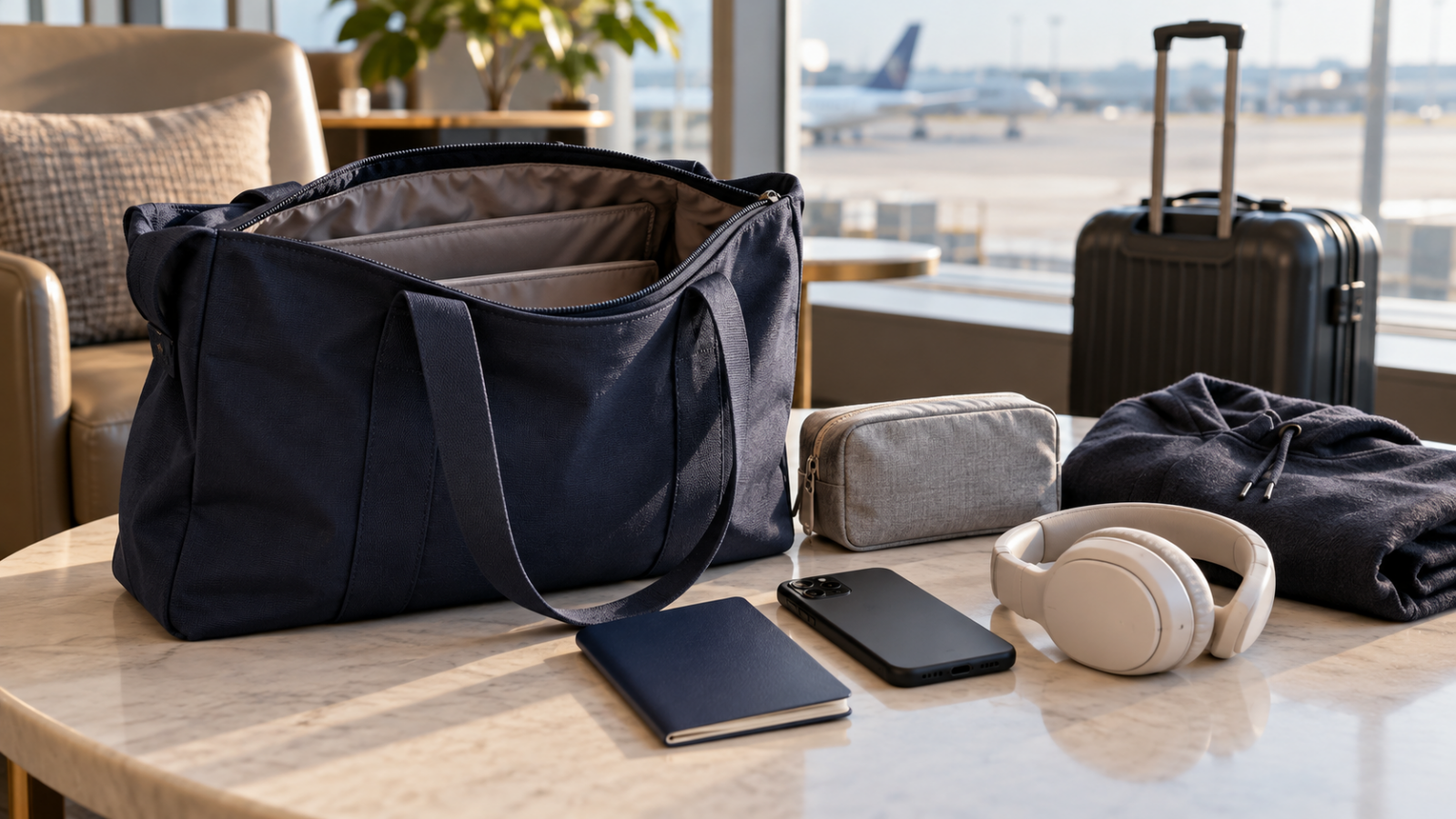
A yes belongs in the personal item. A shrug belongs somewhere else. That is the starting method, and it is different from asking what fits. One override applies: essential medication and reasonable contingencies stay with you, whatever the frequency test says. A personal item is not spare capacity. It is the access layer of your luggage: the bag you open while boarding, in the air, in a queue, or during a delay, when the overhead bin is not an option.
This guide covers that layer only. What goes in the main bag for a full week is a separate job, covered in how to pack a carry-on for seven days.
Sort by consequence and access
Every candidate item gets two tests: what happens if you cannot reach it, and how often you will need it before landing. Consequence outranks frequency: essential medication, and reasonable contingencies for a delay, stay with you even if you do not expect to use them.
Swipe horizontally to compare all columns. Keyboard: focus the table and use the arrow keys.
| Tier | Test | Examples |
|---|---|---|
| 1. Stays with you | Hard or costly to replace mid-journey, or needed on a schedule | Passport and other travel documents, boarding passes, payment cards, essential medication with a margin for delays, power bank |
| 2. Useful in the air | You will probably reach for it before landing | Phone and one charging cable, headphones, a layer or scarf, something to sleep with, snacks if a delay is plausible |
| 3. Not needed until you land | You will not open it in transit | Spare clothes, a laptop you will not use in flight, most of your toiletries, extra shoes |
Tier 3 goes in the main bag. Tier 1 and 2 compete for the space under the seat. The “Worth Bringing” view is that Tier 1 always wins. This is a way of ordering decisions, not a formula.
Three example loadouts
These are worked examples built from the sort above. They are analysis, not tested kits, and your own list will differ.
Swipe horizontally to compare all columns. Keyboard: focus the table and use the arrow keys.
| Trip | Keep within reach | Leave in the main bag |
|---|---|---|
| Short daytime flight | Documents and boarding pass, phone, cards, essential medication, including an appropriate margin for delays, one cable | Spare clothes, full toiletry kit, laptop you will not open, second pair of shoes |
| Long-haul overnight | All of the above, plus a compliant power bank, headphones, a scarf that doubles as a light blanket, something for sleep, snacks | Next-day clothes, toiletries beyond what security requires you to separate, cables you will not use in flight |
| Multi-leg trip with a tight connection | Documents and boarding passes for every leg, phone and power bank, medication for the whole journey including a delay, a snack | Anything you would only unpack at the destination |
Two notes on reading these tables:
- The long-haul row is a ceiling, not a target. Comfort needs are individual. Be specific about contingencies: a spare dose of essential medication for a delay is a reasonable one, while an item you cannot name a use for usually is not.
- Think about gate-checking. A carry-on can be moved to the hold at short notice. Anything in Tier 1 is safer in the bag that stays with you.
The rules that are not optional
Some of this is regulation, not preference. Airline and security rules change, so treat this as a baseline and check your airline before you fly.
Power banks and spare lithium batteries must stay in carry-on baggage, including when a cabin bag is taken for the hold. Protect them against short circuits. Damaged or recalled batteries may be prohibited; check the operating airline’s rules for the specific item.
IATA’s guidance dated 31 March 2026 separates power banks from other spare batteries: it limits power banks to two per person, prohibits recharging them on board and recommends not using them to charge another device during flight. Airlines can impose stricter restrictions. Do not assume a large-capacity power bank is accepted; confirm its watt-hour rating and the airline’s current carriage and use rules before travel. The two-power-bank limit is not a blanket rule for every spare battery.
Medication. Keep essential medication with you, including a reasonable contingency for delays. Check the actual route’s screening, documentation and destination import rules; requirements for controlled medicines can differ.
Liquids. Limits are set by the security authority at your departure airport, they differ between countries and in places between airports, and they change. Check the rule for each airport on your route shortly before you travel. How to organise a toiletry kit around that is in how to organise carry-on toiletries.
Sources for this section: IATA power-bank guidance dated 31 March 2026 (opens in a new tab); FAA PackSafe guidance (opens in a new tab).
Your airline sets the size
There is no universal personal-item allowance. Allowances vary by airline, fare, cabin and sometimes route. These examples show the spread. They are illustrations from published airline pages, not a market survey.
Swipe horizontally to compare all columns. Keyboard: focus the table and use the arrow keys.
| Airline | Personal item or small cabin bag | Weight |
|---|---|---|
| American Airlines | Up to 45 × 35 × 20 cm | No separate personal-item weight limit stated on the cited page; check your itinerary |
| easyJet | Small cabin bag up to 45 × 36 × 20 cm, including handles and wheels | Up to 15 kg; you must be able to lift and carry it |
| Air India | Up to 40 × 30 × 20 cm | Up to 3 kg |
Allowances and exceptions can depend on the departure point. Emirates economy normally permits one cabin piece, with route-specific conditions; this is not a universal prohibition on exempt personal objects. Qantas’s published international-economy personal-item provision has an exception for flights departing India. Check the airline, fare and actual route close to travel.
Sources for this section: Air India baggage guidance (opens in a new tab); easyJet cabin bags (opens in a new tab); American Airlines carry-on baggage (opens in a new tab); Qantas carry-on rules (opens in a new tab); Emirates cabin-baggage rules (opens in a new tab).
Choosing the bag, only if you need one
Start with a buy-nothing test. A bag you already own may be enough if it fits your airline’s current personal-item rule when packed, holds your Tier 1 and 2 items, and is comfortable to carry and reach.
If you are buying, compare listed specifications:
- Filled dimensions against the smallest rule on your trip. Compare the stated size to the tightest allowance you will face, and remember a loaded bag bulges beyond its empty size.
- Empty weight. Some airlines cap personal-item weight. Every gram of bag is a gram of allowance.
- Access. Look for a pocket or opening for documents and phone that does not require opening the main compartment.
- How it carries. Check the straps and handles suit how you will carry it, and whether it combines with a rolling bag if you use one.
- No “fits every airline” claims. No listing can promise that. Compare the dimensions yourself.
For the main bag, see travel backpack vs rolling carry-on and how to choose a carry-on travel backpack.
Easy ways to overload a personal item
A personal item usually fails by becoming an overflow bag. Typical culprits are a full toiletry kit, a second pair of shoes, or a laptop bag full of cables that never leave the bag in flight. Each is reasonable on its own. Together they leave you rummaging for a passport. If you need help with volume discipline in general, how to stop overpacking tackles it directly. For cables and chargers specifically, whether a pouch is worth carrying is covered in do you need a travel tech pouch.
Pack the personal item for the few hours when you cannot reach anything else.
This guide is research-based and does not report hands-on testing of the products discussed. Airline and security rules change; check the operating airline and airport close to your travel date.