
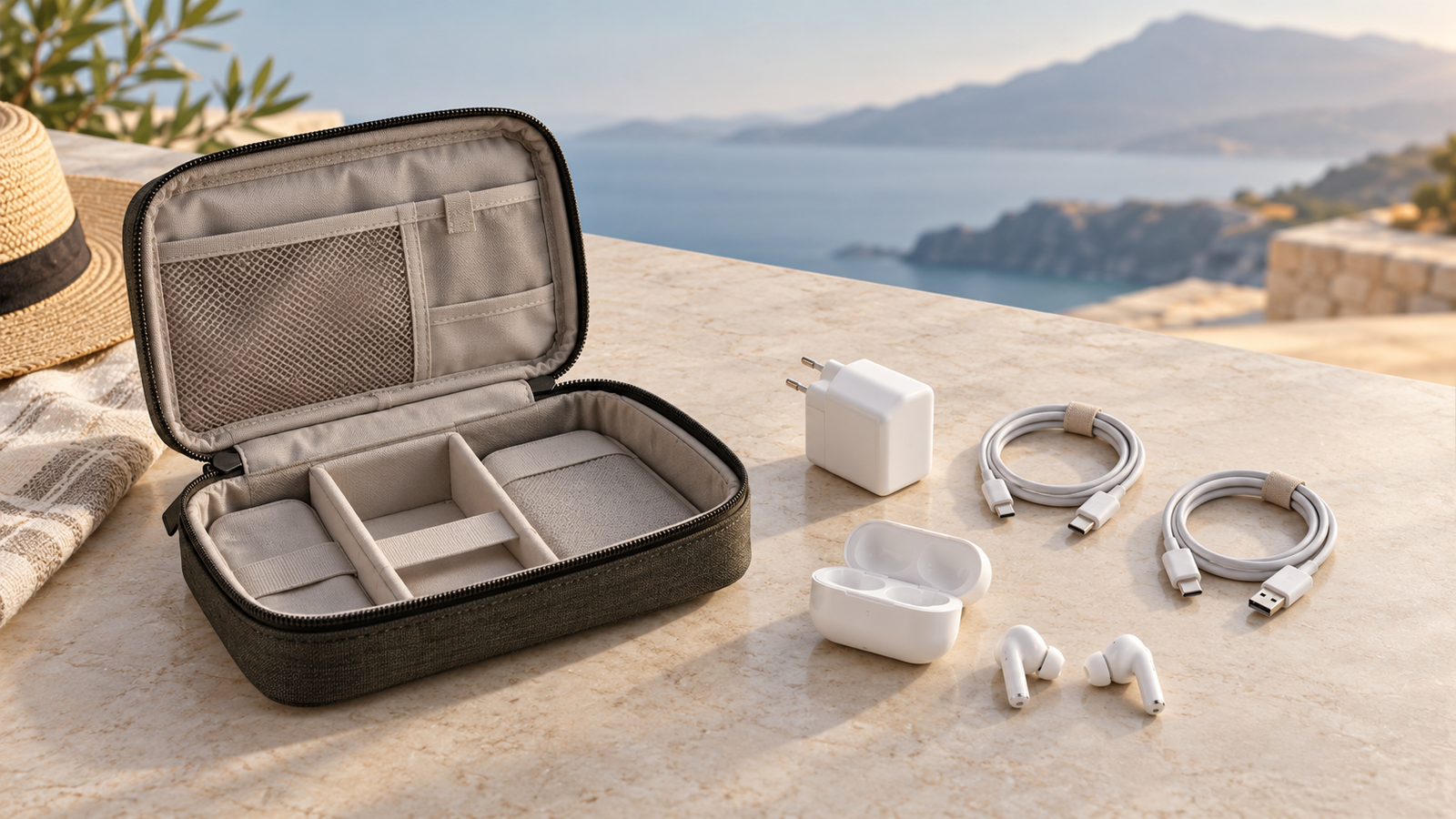
Which items belong in your personal item is covered in what to pack in a personal item bag. This guide starts one step later: you know what you are carrying, and you are deciding whether to buy something to carry it in.
Step 1: Lay out the kit
Put every cable, charger, adapter, power bank and accessory you actually travel with on a table. Then note four things:
- How many items there are.
- Which you reach for often and which only on arrival.
- The biggest or longest item, usually a charger or laptop cable.
- Whether the kit moves between bags, for example from your carry-on to a day bag, or stays in one place.
Step 2: Do you need a pouch at all?
Swipe horizontally to compare all columns. Keyboard: focus the table and use the arrow keys.
| Your kit | Likely answer |
|---|---|
| A handful of items, stays in one bag with zip pockets | Nothing new. An existing pocket does the job |
| A handful of items, but the bag has no internal pockets | A pouch, case or bag you already own |
| A larger multi-item kit that you lift between bags | A dedicated pouch may earn its place |
| A larger kit that never moves | Probably still nothing new; the “carry as one unit” benefit goes unused |
Depending on its design, a dedicated pouch may do two things: keep electronics physically apart from clothes, toiletries and papers, and make a multi-item kit one object to lift in and out. Nothing in the sources behind this guide supports claims that pouches prevent tangles, extend cable life, protect devices or save a measurable amount of time. Judge on weight, size and fit.
Step 3: If yes, soft or structured?
The real choice is how much shape you want. This is reasoning from how the formats behave, not a measured result, and the real penalty depends on the specific pouch and how you load it.
Swipe horizontally to compare all columns. Keyboard: focus the table and use the arrow keys.
| Factor | Softer organiser | More structured pouch |
|---|---|---|
| Fit in a packed bag | Can be squeezed and folded into gaps | Tends to conform less to unused gaps |
| How the kit sits | Contents may shift unless dividers, loops or pockets hold them | May hold items in defined places, if its dividers, loops or pockets are designed to |
| Lifting between bags | Can work well if it closes securely around the kit | Can be easier to move as one unit, if its closure and design keep the kit together |
| Protection | Not established | Not established. Structure and padding may separate electronics from other items, but no sources show a measurable level of impact protection |
| Best when | Your bag has irregular gaps to fill | You want a defined shape more than flexibility |
Structure on its own does not organise anything. Whether a pouch keeps cables apart, holds items in place or stays closed depends on its actual design: dividers, loops, pockets, closure and opening style. Read the listing for those features and judge the pouch by them, not by whether it is stiff or soft.
Ask your bag, not the pouch: does it have gaps a softer organiser could use, or a clear rectangular space for something firm? If you carry something fragile or valuable, do not assume any pouch will protect it from drops or crushing.
Step 4: Size the pouch to the kit
A pouch bigger or more divided than your kit adds weight and bulk for nothing. Pack your real kit into something you already own, then compare it with the listed internal dimensions and capacity of any pouch you are considering. Check that your longest item fits.
Read the listing for four things: listed weight, dimensions, capacity, and how the maker describes weather resistance. Two examples show what the information looks like. They are examples of what to read, not recommendations or rankings.
Swipe horizontally to compare all columns. Keyboard: focus the table and use the arrow keys.
| Product | Listed details | What it tells you | What it does not |
|---|---|---|---|
| Aer Cable Kit 3 | Standard Black listing: 0.6 lb (about 270 g), manufacturer-listed 25 × 15 × 7 cm, 2.6 L; 1680D Cordura exterior and 840D nylon face with weather-resistant coating. Other configurations differ | The weight you carry before packing anything, and the footprint | A typical figure for the category, or how it performs in your bag |
| Peak Design Tech Pouch (Regular) | Selected Regular nylon listing describes organisation, access and weather-resistant construction; check the exact fabric and colour version | How the maker positions it | An independent waterproofing result. “Weatherproof” is a manufacturer claim |
Sources for this section: Aer Cable Kit 3 standard Black listing (opens in a new tab); Peak Design Tech Pouch listing (opens in a new tab).
Step 5: Try what you own first
Plenty of everyday items can do the job:
- An existing zippered pocket in your backpack or personal item
- A pencil case or cosmetic pouch
- A simple zip pouch or heavy-duty zip bag
- An organiser you already own
Pack your kit into one of these for a single trip. If it works, you have saved the money. If something bothers you, such as the kit migrating around the bag or nothing lifting out as one unit, you have learned exactly what a dedicated pouch would need to fix. That makes any later purchase better informed.
When extra organisation becomes clutter
- The kit is small and already fits in a pocket.
- The pouch has compartments you will not fill.
- A firm pouch has to be wrestled into position.
- The kit never moves between bags.
- You are packing to fill the slots, not because you need each item.
Decision test
- How many items do you carry? A handful points to nothing new.
- Do you move the whole kit between bags? If not, the main benefit does not apply.
- Does your bag have gaps or a defined space? That decides soft or structured.
- Does anything you own already do the job? Try it first.
- Does a pouch fit the kit, with listed weight and size you can live with?
If most answers say “small kit”, “doesn’t move” or “I own something”, buy nothing. If your kit is larger, you move it, and nothing you own holds it cleanly, a pouch is worth shortlisting.
This guide is research-based and does not report hands-on testing of the products discussed. Product details are drawn from manufacturers’ official information and are examples, not rankings. Manufacturer claims are attributed as such.