
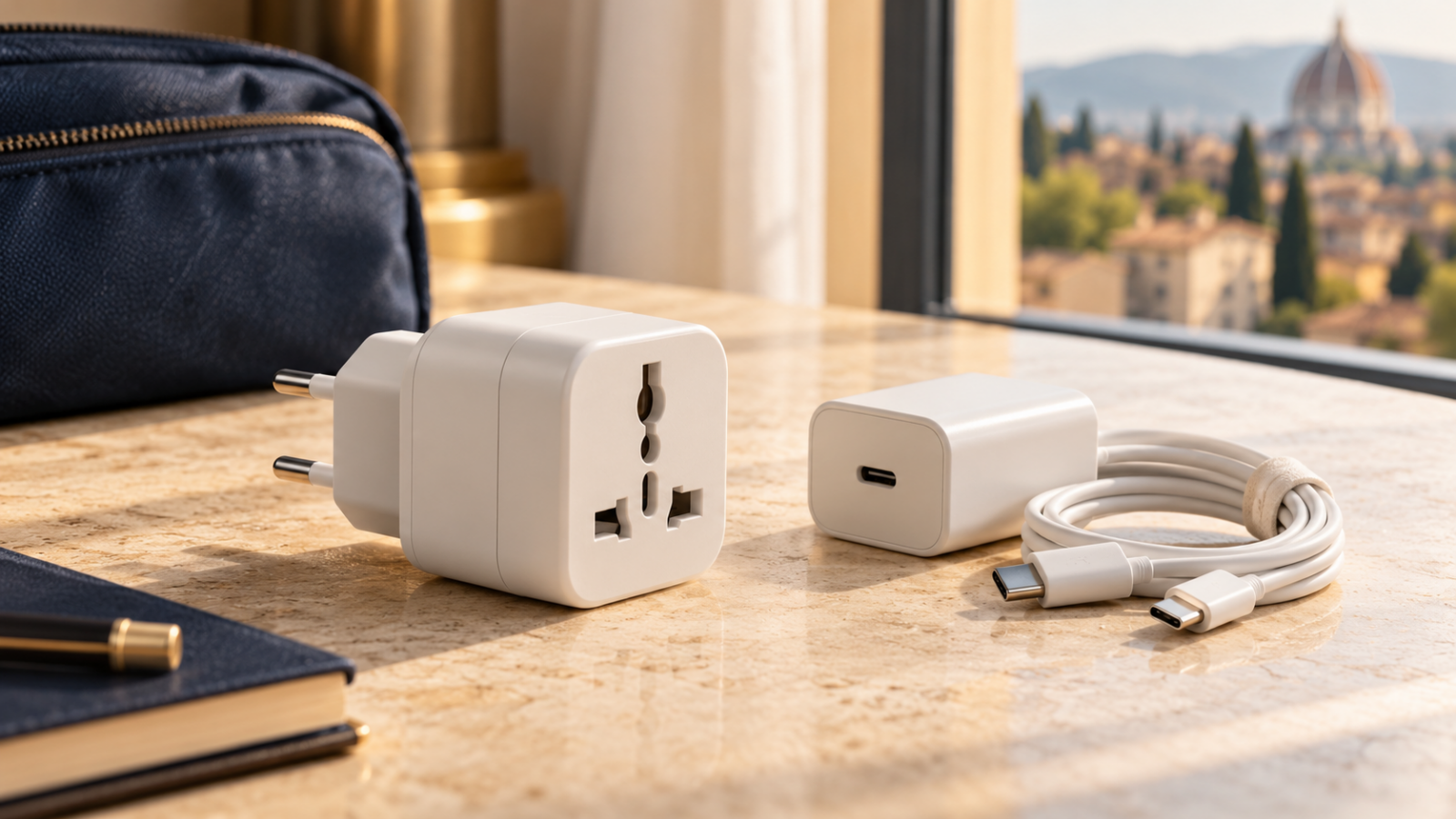
It does not change voltage or frequency, and it does not make an incompatible appliance safe to use. Plenty of buying mistakes start from treating “adapter”, “converter” and “charger” as the same thing. They are three different jobs.
Three jobs, not one
Swipe horizontally to compare all columns. Keyboard: focus the table and use the arrow keys.
| Item | What it does | What to know |
|---|---|---|
| Plug adapter | Changes the physical shape of the plug so it fits a different socket | Does not change voltage or frequency. Its AC outlet does not convert mains voltage |
| Voltage converter or transformer | Changes voltage | A separate device. Whether one is suitable depends on the appliance, its power draw and the converter’s design. It is not a feature of a plug adapter |
| USB charger or power supply | Converts mains AC to the DC your phone, tablet, laptop or other electronics need | Many accept a wide input range, but confirm it on the specific unit, not by category |
Solving a voltage problem with a plug adapter is a category error.
Adapters with USB ports. Many travel adapters have USB ports built in. These are two different things in one housing. The adapter’s AC outlet changes only the plug shape and does not convert mains voltage. A built-in USB port is a separate charger that converts mains power to the DC output a device needs. Its input range and output limits have to be confirmed on the product itself. A built-in USB charger does not make the AC outlet voltage-safe for an appliance.
Sources for this section: Electrical Safety First investigation and safety advice (opens in a new tab).
The checklist
Work through these in order before buying anything.
Swipe horizontally to compare all columns. Keyboard: focus the table and use the arrow keys.
| # | Question | Where to look | What the answer means |
|---|---|---|---|
| 1 | What socket type does your destination use? | An authoritative source for that country | Tells you the plug shape you need to adapt to |
| 2 | What voltage and frequency does the destination supply? | The same source | Tells you what your devices must accept |
| 3 | What does each device’s power supply accept? | The label on the brick, not the device. Look for something like Input: 100–240V ~ 50/60Hz | A matching range means it is designed to accept that mains power. Read each device individually |
| 4 | Do you need plug adaptation, voltage conversion, more charging capacity, or nothing? | Your answers to 1–3 | Name the problem before you shop |
| 5 | What is the smallest compliant solution for this itinerary? | Product listings | Smallest that covers this trip, not the widest on sale |
A matching input label does not tell you everything. It does not confirm that the plug physically fits the socket. It does not cover an appliance that bypasses the power supply. It does not confirm earthing is preserved once an adapter is in the path. And it says nothing about the other items in your bag.
Stop: heating appliances
Hair dryers, straighteners, kettles and other heating appliances need their own decision. A plug adapter does nothing about a voltage mismatch, and running a single-voltage heating appliance on the wrong supply can create a serious electrical-safety problem.
Check the appliance’s stated input-voltage range, the destination supply, the rated current and power of any adapter or converter, and whether earthing is required, and follow the manufacturer’s instructions. There is no reliable shortcut and no improvised workaround. For many trips the simplest answer is to ask whether the appliance needs to come at all.
What “universal” means
“Universal” is a marketing and category term, not a certification. It describes a product designed to fit a wide range of sockets. It is not proof that a particular unit works with every socket, voltage, appliance or country. A maker’s “works in X countries” figure is a manufacturer claim until independently verified.
Different plug and socket styles are in use worldwide. Whether a universal adapter covers your destination’s style varies by product, so check the specific model’s stated compatibility against your destination. Don’t assume it includes or excludes any plug type.
Safety: what one UK investigation found
In 2026, Electrical Safety First purchased 14 travel adapters from online marketplaces (AliExpress, eBay, Amazon Marketplace and TikTok Shop) and tested them against UK safety requirements. Eight were marketed as universal and six as basic or destination-specific. All 14 failed basic UK safety tests.
Reported failures included exposed live pins, dimensional and mechanical-strength failures, missing shutters or fuses and loss of earth connection. These findings describe the purchased sample, not every unit or listing in either category.
How to read this:
- It was a small purchased sample, not a representative sample of the market.
- It tested against UK requirements. It does not describe other countries’ standards.
- It does not show that every universal adapter is dangerous, that every marketplace listing is unsafe, that destination-specific designs are safer, or that a well-known brand is automatically compliant.
- It does show serious design and manufacturing failures in both categories. Unbranded or poorly designed adapters can present real electrical-safety risks.
Electrical Safety First identifies BS 8546 as the applicable safety standard for travel adapters with a UK plug or socket section. A compliance statement in a listing is not proof that a specific unit complies.
What to check on a listing. These come from the failures the investigation reported. They are checks to make, not guarantees that a product passes:
- Whether the maker states which standard it was designed to.
- Whether the design has safety shutters and a fuse where the destination’s plugs call for them.
- Whether the earth connection is kept for earthed plugs.
- Whether the brand and seller publish identifiable contact and compliance information. Treat anonymous marketplace listings with extra caution.
Sources for this section: Electrical Safety First investigation and safety advice (opens in a new tab); Electrical Safety First investigation and safety advice (opens in a new tab).
USB-C can reduce chargers, not sockets
USB-C and USB Power Delivery can cut the number of chargers you pack. USB-IF describes USB PD 3.1 power delivery up to 240 W, depending on the charger, cable and device all supporting it.
But consolidation is not the same as socket compatibility. One multi-port USB-C charger can replace several only if:
- each device actually charges over USB;
- the charger delivers enough power, with the right protocol, on every port you use; and
- the charger’s own mains plug, or an interchangeable head, physically fits the destination socket.
Not every USB charger accepts 100–240 V input either. Check the specific unit. USB-C shrinks what you carry. It does not remove the plug question. Whether the cables and chargers you do carry need a pouch is a separate decision, covered in do you need a travel tech pouch.
Sources for this section: USB IF USB Power Delivery (opens in a new tab).
When a smaller purchase, or nothing, is enough
- One destination, devices already accept its voltage: a compliant destination-specific plug adapter may be all you need, if the only problem is plug shape. A universal adapter becomes more relevant when an itinerary crosses several plug systems.
- Nothing new needed: the destination uses a plug system you already have covered, your charger came with the right interchangeable head, or you already own a compliant adapter for that destination.
- A detachable mains cable can sometimes be replaced locally, but that is a small purchase, not free.
- Don’t plan around hotel sockets. USB ports or “universal” sockets vary by property and cannot be relied on unseen.
This guide is research-based and does not report hands-on testing of the products discussed. Electrical standards, plug and voltage details and test findings should be confirmed from current official sources before you travel or buy.