
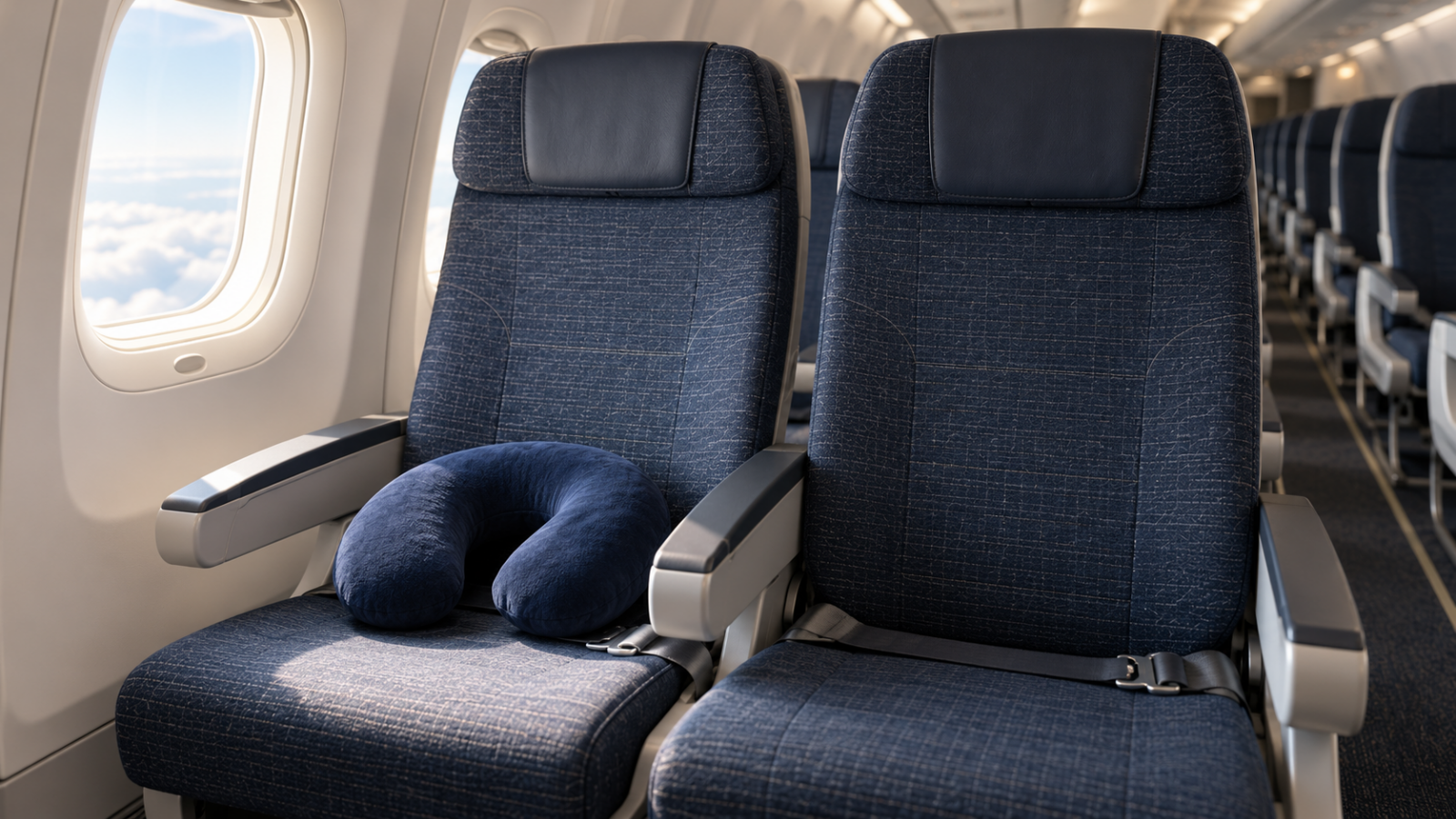
A travel pillow has one job: to support your head if you fall asleep sitting up. It costs bag space, and the job only matters in a narrow set of situations. So start with the situation, not the shape or the brand.
Quick read by situation
This table is “Worth Bringing” analysis based on how the pillow’s job fits each situation. It is inference, not a test result.
Swipe horizontally to compare all columns. Keyboard: focus the table and use the arrow keys.
| Your situation | Case for a pillow | Why |
|---|---|---|
| Overnight long-haul, economy, middle or aisle seat, and you plan to sleep | Strongest | No wall to lean on, a specific several-hour stretch where head support is missing, and few obvious substitutes |
| Overnight long-haul, economy, window seat | Weaker | The cabin wall is a no-cost substitute, especially with a folded jacket or blanket as padding |
| Seat with adjustable headrest wings | Weaker | The seat’s own side supports may already do part of the job |
| Premium cabin, lie-flat seat, or bedding supplied | Weakest | The gap the pillow fills may not exist |
| Short-haul or daytime flight, and sleep is not the plan | Weakest | The carrying cost is hard to justify |
| You already carry a jacket, hoodie or scarf you would bundle | Possibly redundant | It will not behave like a purpose-built pillow, but it may close enough of the gap |
If your row says “strongest”, read on for what to look for. If it says anything else, the case on paper is weaker. Comfort is individual, though, so a weaker case does not mean a pillow will not suit you.
The Worth Bringing test
- Space: what it costs to carry. This varies by format.
- Use: the specific moment it exists for. For a pillow, that is seated sleep with no other head support.
- Replacement: what you would do without it. A wall, a rolled layer, or an airline-provided pillow where offered.
What the evidence does and does not show
Zhang, Meng, Gong and Wang’s 2021 study of sleep in a simulated economy-class seat without head support compared backrest angles of 90° and 110°. Its abstract reports greater head and neck rotation and neck-muscle fatigue at the more reclined angle. This was not a travel-pillow trial and does not establish that a pillow would solve the problem.
The sources assembled for this guide do not establish whether consumer travel pillows improve sleep or prevent symptoms during upright aircraft sleep. Research about pillows used lying down cannot settle that different question.
Swipe horizontally to compare all columns. Keyboard: focus the table and use the arrow keys.
| Common claim | What the sources show | How to read it |
|---|---|---|
| Improves sleep quality or duration | The sources assembled for this guide do not establish this benefit for travel pillows | Unsupported |
| Prevents neck pain or improves alignment | Related studies in the sources reviewed use bed pillows, lying flat | Does not transfer automatically to an upright seat |
| Prevents stiffness or headaches | Research on pillows used lying down does not establish whether a consumer travel pillow prevents these symptoms during upright aircraft sleep | Indirect at best; not evidence about travel pillows |
| Stops your head slumping or rolling | Mechanically plausible: a pillow filling the gap limits how far the head can travel. The sources reviewed contain no comparison of formats | A design rationale that still needs product-specific evidence |
| Reduces travel fatigue | Seat-angle research links posture to neck-muscle fatigue; travel fatigue has many other causes | Not shown |
| Improves circulation | No supporting evidence or mechanism in the sources reviewed | Set aside |
Nothing here is a promise that a pillow will improve your sleep, comfort or health. The case that survives is a mechanical one: support for a head that would otherwise drop or roll.
Sources for this section: Zhang et al 2021 aircraft-seat study DOI 10.1016/j.ergon.2020.103074 abstract (opens in a new tab).
Match the shape to how your head falls
If your head tends to drop forward when you doze, a pillow built for side support may do less for you than one built for the front. Check which way your head goes, then compare formats. These are mechanisms from design, not tested rankings, and the sources assembled for this guide do not establish a reliably superior shape.
Swipe horizontally to compare all columns. Keyboard: focus the table and use the arrow keys.
| Format | Built around | What to check |
|---|---|---|
| U-shaped foam | Designed to place support around the sides of the neck; fit and forward support vary by product | Design rationale, not demonstrated performance; assess the specific design and fit |
| Inflatable U-shaped | The same principle with an air chamber, generally taking up less packed space | Valve and chamber durability can only be judged for a specific product |
| Wrap or scarf style | Internal rigid or semi-rigid support in fabric, holding the head and jaw from the side | Heat retention and collarbone pressure are unverified questions |
| J-shaped or chin support | Giving the chin somewhere to rest, for heads that fall forward | A reasonable design response, not demonstrated superiority |
If you decide to buy: what to check
Comfort cannot be judged from a listing, so use the listing to check what it can tell you:
- Packed size and weight, against the space you would give up.
- How it attaches to a bag, if you want it outside the main compartment.
- Adjustability: closure, fit or inflation level.
- Support shape that matches how your head falls.
- Cover and care: whether it is removable or washable.
- Returns policy, since you cannot test comfort before you travel.
Do not assume a neck pillow is exempt from your carry-on or personal-item allowance. Policies vary by airline and fare.
Instead of buying
- The cabin wall, on a window seat, padded with a jacket or airline blanket.
- An airline-provided pillow or blanket, where offered. Availability varies by airline, route, cabin and aircraft, so check your flight.
- The seat’s own headrest wings, on aircraft that have them.
- A scarf or layer you are already carrying, which also fits the individual comfort needs described in what to pack in a personal item bag.
- Nothing. For short flights, daytime travel, premium seating, or anyone who does not find seated sleep a recurring problem, skipping the purchase is a legitimate outcome.
A pillow is most worth considering when your trip matches the first row of the table: overnight, economy, no wall, and a real plan to sleep. Outside that, many travellers may reasonably skip one, and some will still carry one for comfort. That is an individual call.
This guide is research-based and does not report hands-on testing of the products discussed. It makes no health or sleep-benefit claim.