
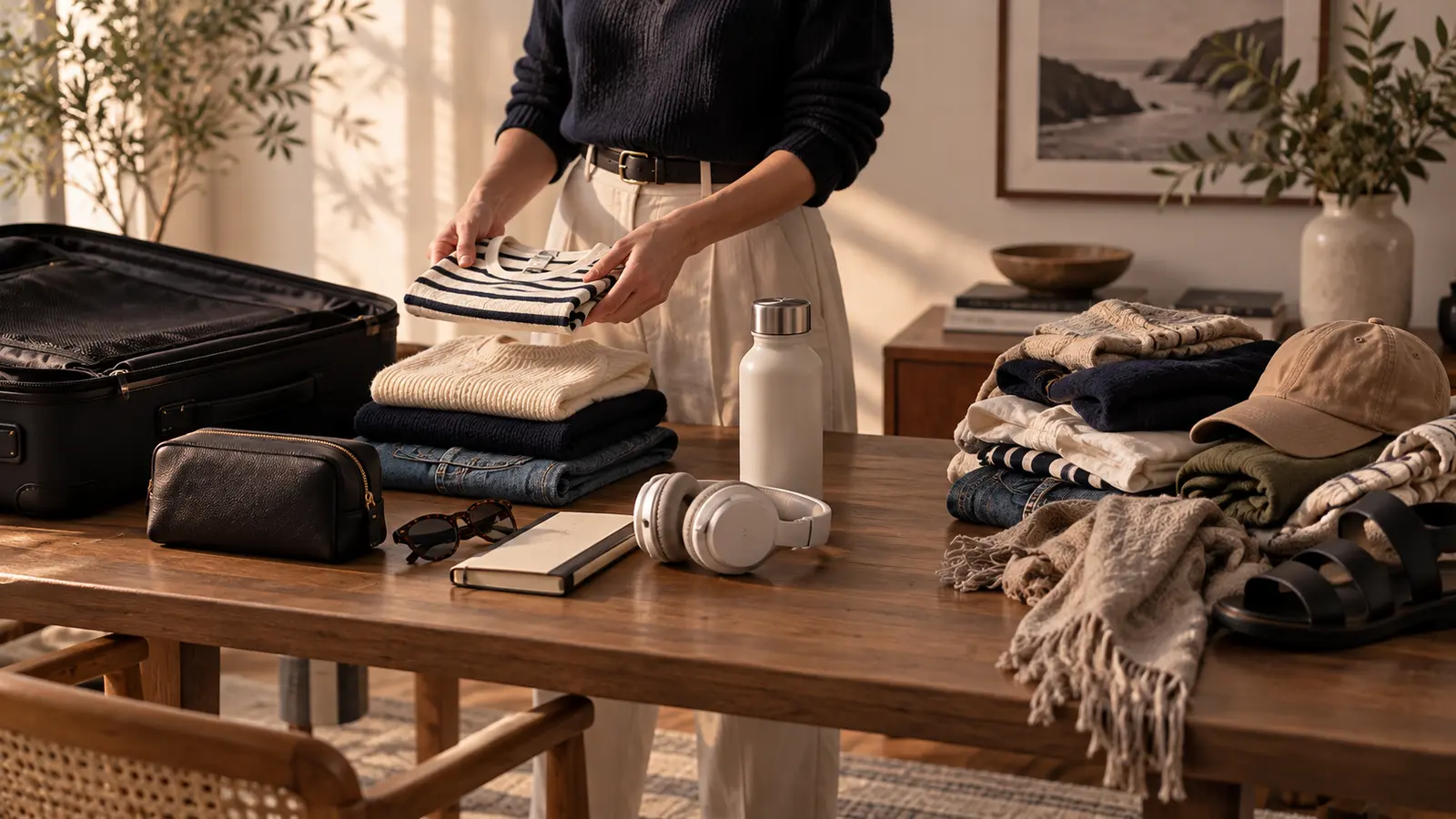
The goal is not to carry the fewest possible things. It is to remove items whose burden is larger than the problem they solve while protecting medical, adaptive, caregiving, formal and remote-trip needs.
Overpacking is therefore not solved by tighter folding. It is solved by a repeatable rule for answering, “What happens if I leave this behind?”
Overpacking starts before the bag is full
A full bag is the visible outcome. The earlier decision is the useful place to intervene.
An item can enter the pile because it serves the itinerary. It can also enter because the traveller imagines a discomfort, delay, change of mood or unlikely event and wants to prevent regret. Both motives are understandable. They should not receive the same packing decision automatically.
General decision research provides two relevant ideas:
- Anticipated regret: research shows that expected feedback about forgone options can influence decisions under uncertainty, sometimes towards risk avoidance and sometimes towards risk taking. Applying this to packing is our interpretation.
- Cognitive offloading: research by Risko and Gilbert describes how moving information into an external aid—such as a written note—can reduce the demand placed on internal memory.
Neither finding proves that a particular person overpacks because of anxiety, nor does it establish a clinical travel condition. “Worth Bringing”’s application is narrower: imagined future regret can make an extra item feel safer, and a written packing system can reduce the need to hold every possible need in mind at once.
That is an analytical bridge from general research to packing—not a diagnosis.
Start with a hard, real constraint
Without a boundary, every candidate item can coexist in the plan. A constraint forces trade-offs to become visible.
Use the boundary that actually governs the trip:
- the airline's current size and weight allowance;
- a bag already owned and safe to carry;
- a mobility or lifting limit;
- the space available in shared transport; or
- the amount the traveller is willing to move between accommodations.
The boundary should come from the journey, not from a minimalist identity. A smaller bag is not automatically better, and a large bag does not require filling.
If the task is to execute a one-week load within a verified allowance, use How to Pack a Carry-On for 7 Days. This article owns the decision habit that comes before that concrete pack.
Sort the list into must, likely and just-in-case
This three-bucket method is “Worth Bringing” analysis. It is designed to reveal why an item is present; it is not a behavioural test.
Must
The trip cannot proceed safely, legally or as planned without the item, or the consequence of its absence is unacceptable.
Examples can include travel documents, prescribed medicine, adaptive equipment, required work tools and clothing tied to a confirmed event. A “must” should have a specific consequence, not merely a familiar place on an old list.
Likely
The item serves a named activity, expected condition or repeated daily need. Its use is supported by the itinerary, current forecast, accommodation or role.
Likely items form the working load. They still need to be compatible with each other and proportionate to the trip.
Just-in-case
The item addresses a possible scenario that is not currently part of the plan. That does not make it wrong. It means the consequence and replaceability need examination.
A spare medicine prescribed for contingency can remain essential. A third variation of the same casual outfit may not. The bucket exposes the decision; it does not make it for the traveller.
Apply the Space–Use–Replacement Test
For every uncertain item, evaluate three dimensions.
1. Space: what burden does it add?
Consider more than volume. Does it add dense weight, require a protective case, create an awkward rigid shape or force another item out? Will it be carried through every transfer?
The relevant burden is relative to the bag and movement pattern. A compact object in a checked case and the same object in a strict hand-baggage allowance create different decisions.
2. Use: what exact situation is it for?
Name the day, activity or condition. “Dinner on Tuesday at a formal venue” is evidence of use. “Maybe I will feel like wearing it” is a weaker case.
Then ask whether an item already selected can perform the same job adequately. The standard is not perfect substitution; it is whether the alternative keeps the trip functional and acceptable.
3. Replacement: what happens if it is absent?
Replacement includes buying, borrowing, washing, renting, repairing, sharing or going without. Evaluate:
- whether the option will actually be available;
- the time and accessibility required;
- the financial and environmental cost;
- whether a substitute must meet a medical, safety, fit or quality standard; and
- the consequence if replacement fails.
There is no universal “buy it for under a fixed amount in a fixed number of minutes” rule. A low-cost item can still be hard to source; an expensive emergency purchase can be rational if the chance and consequence justify carrying the original.
Turn the test into a decision
Swipe horizontally to compare all columns. Keyboard: focus the table and use the arrow keys.
| Result | Decision direction |
|---|---|
| Small burden + named use + difficult consequence | Bring it |
| Large burden + duplicate use + easy acceptable substitute | Leave it behind |
| Necessary function + excessive format | Bring a smaller/shared/multipurpose version where safe |
| Uncertain use + serious consequence of absence | Keep it or obtain authoritative advice |
| Uncertain use + mild consequence + practical replacement | Leave it behind |
This matrix is “Worth Bringing” analysis. It helps expose trade-offs; it does not calculate an objective answer.
Use a removal pass that protects the important things
When the load exceeds its boundary, remove the least consequential burden first. A practical review can move through:
- exact duplicates and backup versions of the same function;
- separate outfits for contexts already covered adequately;
- bulky items attached to unconfirmed scenarios;
- convenience products available through accommodation or a safe substitute;
- entertainment or comfort items that duplicate a device or activity already chosen.
This is not a rigid formula. The traveller may reorder it around medical, cultural, professional, caregiving or accessibility requirements. The point is to prevent a random last-minute cut from removing something important while low-value duplication remains.
After each cut, ask whether the trip is still safe, compliant and workable. Stop when the bag is within the real boundary. Do not keep removing items merely to reach an aesthetic version of minimalism.
Delay weather contingencies until they can be informed
Packing too early can turn every possible weather state into a separate garment. Waiting until the latest responsible planning point allows the current forecast and official travel information to shape the decision.
The “latest responsible point” depends on the trip. It must leave enough time to obtain required equipment, manage laundry and avoid rushed packing. There is no universal number of hours or days.
Use layers that cover a realistic range, then add specialised protection only when the expected conditions or consequence justify it. For severe or remote conditions, authoritative safety guidance takes priority over a light-packing goal.
Close the decision window
Many unnecessary additions enter after the list was already sufficient. Create a closing rule:
- The written list is complete when every confirmed activity and critical need is covered.
- New additions require a named scenario and a Space–Use–Replacement check.
- A replacement does not become an addition; one item must leave when another takes its role.
- Final weighing or measuring is a compliance check, not an invitation to fill unused allowance.
This turns “there is still room” into neutral information. Empty space can be operational margin rather than a vacancy.
Separate an organisation problem from an overpacking problem
A difficult-to-navigate bag may feel overpacked even when the load is appropriate. Conversely, organisers can make an excessive load look controlled.
If every selected item has a defensible role but categories become mixed, read Are Packing Cubes Worth It?. If the bag is truly too full or heavy, an organiser does not remove the decision burden. Return to the list.
Bag format can also change how burdensome the same load feels. When the unresolved issue is carrying versus rolling rather than what to remove, use Travel Backpack vs Rolling Carry-On.
Build a post-trip feedback loop
Memory can preserve the feeling that every packed contingency was necessary even when several items remained untouched. A short audit creates better evidence for the next trip.
At unpacking, record:
- items used repeatedly;
- items used once for a confirmed purpose;
- items not used and why;
- items missed and how the absence was handled; and
- items that were useful but unnecessarily bulky or duplicated.
Do not treat every unused item as a mistake. Rain protection can be justified even when it does not rain; medication can be essential even when the contingency never occurs. Judge the original decision against the information and consequence, not only the outcome.
The next packing list can then change one or two rules at a time. That produces a personal system without pretending one traveller's history is universal evidence.
Who should not pursue aggressive minimalism?
Bringing more can be the responsible choice for:
- people carrying prescription medicine, medical supplies or adaptive equipment;
- parents and caregivers whose dependants need genuine contingencies;
- travellers to remote areas with limited supply, repair or laundry access;
- workers or attendees with non-negotiable formal, protective or technical requirements;
- trips spanning sharply different or safety-critical conditions; and
- anyone whose mobility needs make repeated local replacement impractical.
The Space–Use–Replacement Test should protect these needs, not pressure them out of the bag. “Leave it behind” is appropriate only when the consequence is acceptable to the person carrying it.
Simpler, no-purchase ways to pack less
No new organiser is required. Use:
- a written list tied to the itinerary;
- the current bag as a fixed ceiling;
- a photo or note of unused items after the trip;
- a shared-item plan with travelling companions;
- a laundry decision made before clothing selection; and
- a final 10-minute review focused on duplicate functions.
These actions reduce decisions or duplication directly. A product should enter only when it solves a remaining organisation, protection or access problem.
Worth Bringing verdict
Stop overpacking by replacing vague reassurance with explicit decisions. Protect the musts, build around likely use, and test contingencies against their burden and the real consequence of leaving them behind.
The Space–Use–Replacement Test is not a scientific formula. It is a disciplined way to make trade-offs visible. Success is not the lightest bag; it is a bag whose contents can be explained without apology, panic or invented certainty.
Sources and methodology
This research-based guide uses two strands of general behavioural research and applies them cautiously to travel through a “Worth Bringing” framework. It does not claim that the research directly proves why an individual packs a particular item.
- Zeelenberg (1999) — Anticipated Regret, Expected Feedback and Behavioral Decision Making (opens in a new tab): general evidence that anticipated regret can influence precautionary choice.
- Risko & Gilbert (2016) — Cognitive Offloading (opens in a new tab): general evidence about externalising cognitive demands into the environment.
The must / likely / just-in-case buckets, Space–Use–Replacement Test, removal pass, closing rule and post-trip audit are “Worth Bringing” analytical tools, not externally validated travel standards.