
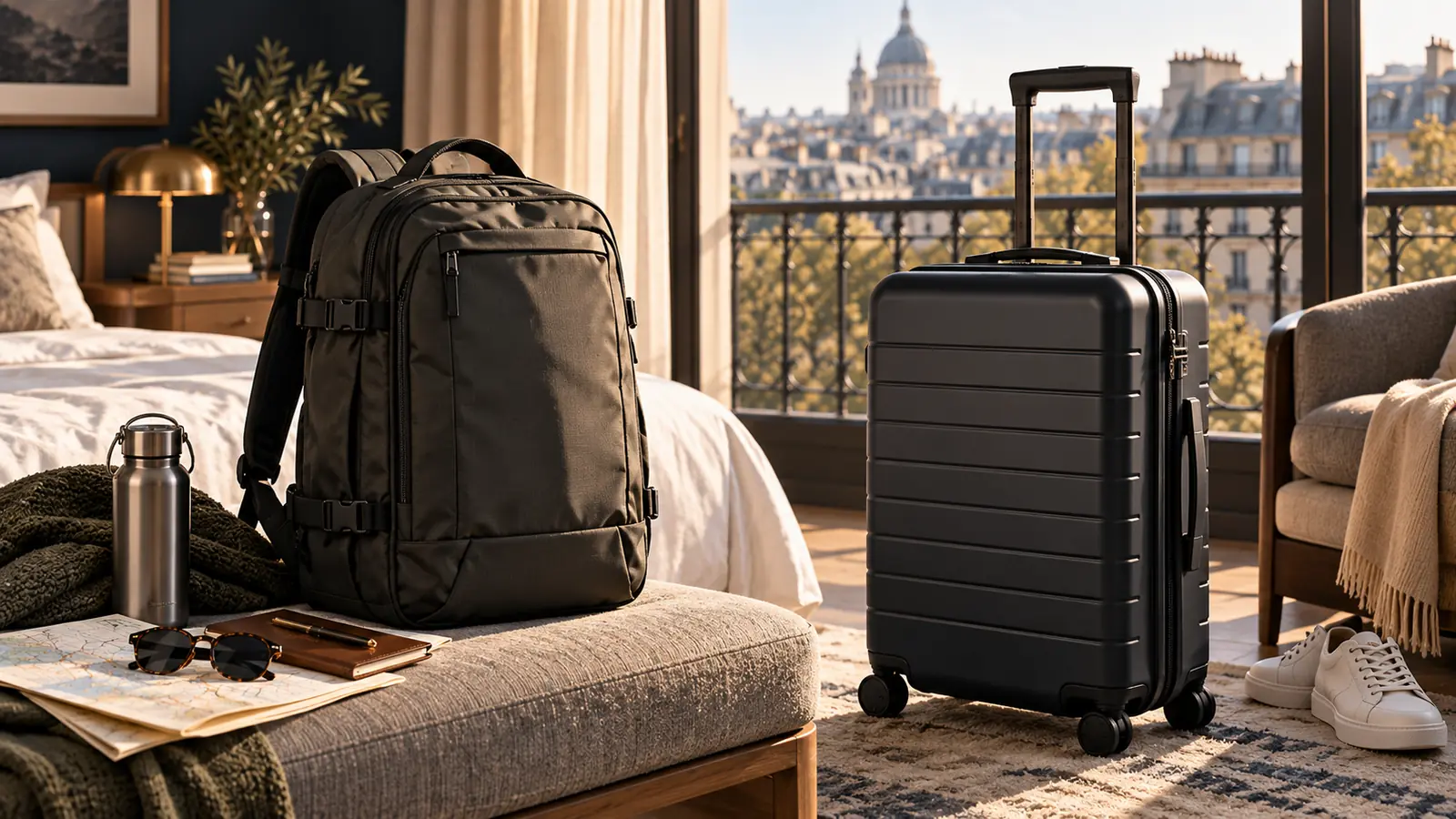
Neither format is the universal lighter, roomier or more comfortable option. Start with what the bag must physically do between home and destination: roll, be lifted, stay on the body, protect its contents, fit the airline envelope and work with the traveller's mobility.
The better bag is the one whose disadvantages appear least in the actual route.
Start with the journey between the endpoints
“Airport to hotel” hides the part of the trip that decides this comparison. Map the complete movement chain:
- home to departure point;
- terminal, security and boarding;
- arrival terminal to local transport;
- stations, pavements, stairs and accommodation access;
- moves between destinations; and
- storage and daily access after arrival.
Record the surfaces, lifting points and walking intervals. A smooth terminal can favour wheels; a fourth-floor walk-up changes the calculation. A backpack avoids wheel contact with rough ground but asks the traveller's body to support the load. A roller transfers its load to the floor while rolling but still has to be lifted into vehicles, overhead bins and stairways.
The decision begins with these transitions, not with a list of bag features.
What a rolling carry-on does well
It moves load through the floor
On suitable surfaces, wheels support the bag rather than the traveller carrying it continuously. This can matter when reducing sustained carrying is an important requirement. It does not remove lifting: kerbs, stairs, luggage racks and overhead bins remain part of the journey.
It provides a stable, structured container
A hard or structured soft case can preserve a predictable rectangular packing space and provide a stable opening at the accommodation. That can suit folded formal clothing, items that benefit from structure or travellers who prefer a suitcase-style layout.
Structure does not guarantee protection from every impact, and a roller does not automatically prevent wrinkles. Those outcomes depend on the exact case, packing method, contents and handling.
It can be easy to live from at one base
A clamshell case placed on a luggage stand gives broad visibility. This is useful when the traveller reaches one accommodation and stops moving the bag. In a small room, however, the open footprint may become a cost.
What a travel backpack does well
It keeps the hands available
A backpack can leave both hands free for tickets, doors, handrails or another permitted item. This advantage matters only if the load and harness are appropriate for the person carrying it.
It is independent of the ground surface
Stairs, broken pavements and gaps do not require the bag's wheels to pass over them. The trade-off is direct: the traveller carries the load during those sections.
It can move through constrained spaces cleanly
A bag kept close to the body can work in narrow aisles, crowded transit and repeated transfers. Its soft structure may also allow some flexibility in storage. That flexibility is not permission to overfill the bag beyond an airline's dimensions.
Weight: compare exact bags, not category slogans
Backpacks are not automatically lighter than rollers. Materials, frames, harnesses, wheels, handles and size all matter.
These three models illustrate why empty weight must be checked individually:
Swipe horizontally to compare all columns. Keyboard: focus the table and use the arrow keys.
| Exact product example | Format | Published empty weight | What the example proves—and does not prove |
|---|---|---|---|
| Away The Carry-On | Hardside roller | 7.5 lb / about 3.4kg | This exact structured case uses a substantial part of a strict allowance; it does not represent every roller |
| Travelpro Maxlite 5 21-inch Expandable Spinner | Softside roller | 5.4 lb / about 2.4kg | A different roller construction produces a different weight; it is not a category average |
| Osprey Farpoint 40 | Travel backpack | 3.27 lb / 1.48 kg | This exact backpack is lighter than the two named examples; it does not prove all backpacks are lighter |
These products differ in construction and are not a controlled like-for-like test. Their value here is to show why the empty weight of the exact shortlisted bag must be checked.
Under any weight-limited allowance, subtract the empty bag weight first. Then weigh the finished load. Do not infer compliance from capacity, marketing labels or format.
Load distribution: floor, hands, hips and shoulders
A roller's wheels carry the load on smooth ground. The traveller supplies force through the handle and bears the full load during lifting.
A backpack's load distribution depends on its structure and fit. REI's backpack-fitting guidance says that, in a properly fitted backpack designed with a load-bearing hipbelt, the majority of the pack's weight—80% or more—should be supported by the hips. That figure must remain attributed; it is not a promise for every travel backpack or every body.
Distinguish two components:
- Padded, load-bearing hipbelt: designed to transfer meaningful vertical load when the torso length and adjustment are appropriate.
- Simple webbing waist strap: primarily limits swing and adds stability; it should not be treated as equivalent to a load-bearing belt.
A poorly fitted backpack can place unwanted pressure on shoulders or other areas. A well-designed harness cannot guarantee comfort without fit and an appropriate load. Travellers with pain, injury or mobility concerns should base the decision on individual professional guidance rather than a category article.
Wheels and handles: the space and failure trade-off
Wheel housings and telescopic handle tracks occupy physical space within or around a roller's shell. “Worth Bringing” treats this as a design trade-off, not proof that a backpack with the same external dimensions always holds more.
The roller gains structure and ground support in exchange for that hardware. A backpack replaces the rolling chassis with shoulder straps, padding and possibly a frame and hipbelt. Those parts also add weight and can affect packability.
Check the usable interior and the external airline envelope of the exact bag. Stated litres are not enough to resolve the comparison.
Terrain, stairs and walking
Swipe horizontally to compare all columns. Keyboard: focus the table and use the arrow keys.
| Route condition | Backpack advantage | Roller advantage | Deciding question |
|---|---|---|---|
| Smooth terminal and paved transfer | Hands remain free | Load stays on wheels | Is sustained carrying or steering easier for this traveller? |
| Stairs and walk-up accommodation | No rolling chassis to lift separately between landings | Can be carried by handles for short sections | How much lifting is required, and by whom? |
| Cobblestones or broken pavement | Avoids wheel friction and vibration | No load on the back during smoother stretches | Is the carried load safer than pulling over the route? |
| Long walking interval | Stable fitted harness can distribute load | Wheels support load on suitable ground | What surfaces dominate the actual walk? |
| Crowded transit | Bag stays attached to the body | Can stand independently beside the traveller | Can the bag be controlled without obstructing others? |
Rollers do not universally “fail” on cobblestones, and backpacks do not erase terrain. Each converts the route into a different physical demand.
Lifting and accessibility
The most important movement may be the one repeated least: placing the bag into an overhead bin.
Assess:
- whether the traveller can lift the packed weight safely;
- whether a two-handed lift is possible;
- whether the bag has suitable handles;
- whether assistance can be relied upon;
- whether the bag must be carried on stairs; and
- whether rolling, wearing or a smaller load best supports the traveller's mobility.
Do not make a medical conclusion from bag format. A roller can reduce sustained carrying but still demand awkward lifting and pulling. A backpack can leave hands free but still be unsuitable for a particular body or load.
Access, structure and contents
Choose a roller when
- broad suitcase-style access helps with the actual contents;
- structure matters more than soft-sided flexibility;
- folded formal clothing or stable compartmentalisation is a priority;
- the route is dominated by surfaces suitable for wheels; or
- reducing sustained carried load is the central need.
Choose a backpack when
- stairs, surface changes or repeated transfers define the route;
- hands-free movement has a specific value;
- the bag must move through narrow or crowded spaces;
- a fitted harness can support the realistic load; or
- soft-sided storage and body-close control matter more than a self-standing case.
These are decision conditions, not statements about what business, leisure or “experienced” travellers prefer.
The hybrid roller-backpack question
A hybrid combines wheel and handle hardware with a carrying harness. That can be useful when a route contains meaningful rolling and carrying segments and the traveller accepts the added hardware.
Its combined hardware does not establish a universal advantage or disadvantage. The correct check is product-specific:
- empty weight;
- harness quality and torso fit;
- how wheels and handle affect the back panel;
- how quickly the carry system deploys;
- internal space claimed by both systems; and
- whether both modes will genuinely be used.
Specifications alone cannot establish that a named hybrid carries comfortably or that its mechanisms remain durable.
Worth Bringing backpack-versus-roller framework
This is an editorial decision framework, not a scientific score.
Swipe horizontally to compare all columns. Keyboard: focus the table and use the arrow keys.
| Question | Points toward a backpack | Points toward a roller |
|---|---|---|
| Ground | Repeated stairs, broken surfaces, constrained transit | Predominantly smooth, accessible routes |
| Body | Realistic load can be carried safely with suitable fit | Sustained back/shoulder carriage should be reduced |
| Journey | Frequent moves and hands-free tasks | Direct transfer and one main accommodation |
| Contents | Flexible clothing load and body-close control | Structure, broad opening or formal contents |
| Allowance | Exact backpack leaves more payload after weighing | Exact roller complies with sufficient payload remaining |
If the signals split, identify the hardest non-negotiable segment. A ten-minute rough transfer can be manageable; repeated unsafe lifting is not. The highest-consequence constraint should lead.
Who should skip each format?
Skip a backpack when
- the packed load cannot be carried safely or comfortably;
- torso fit and load transfer cannot be established;
- structured formal contents dominate the trip;
- the route makes rolling straightforward and carrying adds no useful benefit; or
- mobility or health advice rules out the load.
Skip a roller when
- the route includes repeated stairs or surfaces that make pulling and lifting burdensome;
- wheel/handle hardware consumes an unacceptable share of a strict weight allowance;
- both hands need to remain reliably available; or
- the bag must repeatedly move through spaces where a trailing case is impractical.
Skip the purchase when
An existing bag already meets the route, load, body and airline constraints. Borrowing a suitable format for an unusual trip can be more sensible than owning a second bag.
If the load itself is the problem, address How to Stop Overpacking before changing formats. If the trip needs a concrete one-week packing system, use How to Pack a Carry-On for 7 Days.
Worth Bringing verdict
Choose the format that removes the trip's hardest physical friction. A backpack earns its place when route flexibility and hands-free movement outweigh carrying the load. A roller earns its place when smooth movement, structure and relief from sustained carrying outweigh lifting and terrain constraints.
If the framework points to a backpack, the next decision is fit and specification—not a product ranking. Continue with How to Choose a Carry-On Travel Backpack for One-Bag Trips.
Sources and methodology
This is a specification-based category comparison. The traveller-profile mapping is “Worth Bringing” analysis. It does not claim firsthand comfort, capacity, wheel performance or durability.
- REI Co-op — How to Choose a Backpack (opens in a new tab): expert guidance on the proportion of load supported by the hips in a fitted backpack.
- REI Co-op — How to Fit and Adjust Your Backpack (opens in a new tab): expert guidance on pack adjustment.
- Away — The Carry-On (opens in a new tab): manufacturer specification for the named hardside roller's empty weight.
- Travelpro — Maxlite 5 21-inch Expandable Carry-On Spinner (opens in a new tab): manufacturer specification for the named softside roller's empty weight.
- Osprey — Farpoint 40 Travel Pack (opens in a new tab): manufacturer specification for the named backpack's empty weight.
The three products are examples, not representative category averages or recommendations.